

Video & Blog
Procurement skills in the age of AI: what it takes to thrive
By Mark Hubbard |
The AI-native Procurement Operating Model is not brought to life by technology. It is brought to life by people. That is not a comforting story we tell ourselves but a lesson from 20+ years of procurement transformations and a familiar pattern in the ones that fail.
In our recent webinar, Procurement skills in the age of AI, we brought together experts in operating model design, training, AI, and procurement transformation to go deep on one dimension of the Procurement Operating Model that decides whether the rest ever works: Capability & Mindset. This blog summarises how the skill landscape is shifting, which capabilities matter now, and how to manage the transition.
Start with the model, not the tool
A Procurement Operating Model defines how procurement structures, manages, and executes its work. A Target Operating Model is not just about drawing org charts, but about defining how work flows, how decisions get made, and how procurement connects with the business. It spans six dimensions: Strategy, Business Engagement, Processes & Toolkits, Data & Technology, Organisation Structure, and Capability & Mindset.
AI touches every one of them. But the temptation to lead with the tool is exactly the trap. People remain a key dimension of every operating model, even the AI-native one. Before discussing skills for the age of AI, it is therefore essential to define (agentic) AI in Procurement.
A useful distinction from the webinar around agentic AI was that a chatbot talks, an agent does. Ask a friend for a restaurant recommendation and you have a chatbot; hand them your phone and say “book me a table for Friday” and they go check options, make the reservation, and confirm it is done – you have an agent.
An agent has tools, the autonomy to choose which to use, and a goal it works toward over multiple steps. The impact in procurement is already real: intake agents cutting order processing times, autonomous sourcing agents saving on tail spend, agents speeding up how teams run and evaluate an RFx. This is not future talk. It is happening now.
AI is redrawing the skills framework, not erasing it
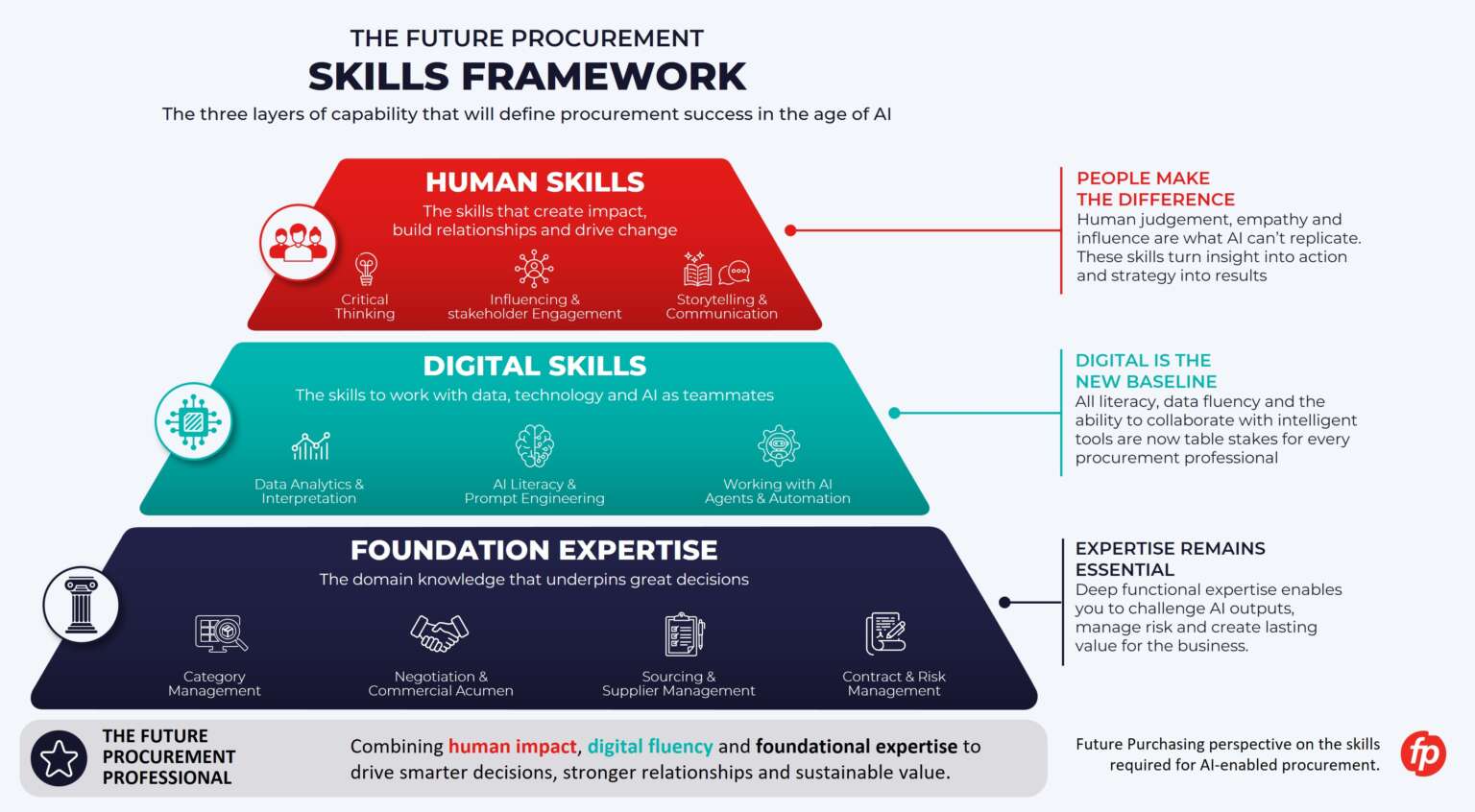
For years, procurement skills frameworks have grouped capabilities into foundational or technical skills on one side and soft or business-partnering skills on the other. Most real-world challenges draw on both, because getting change to stick across teams is as much a human task as a technical one. The important question now is not whether AI makes these skills obsolete. It is which parts of the framework AI enhances, which one it replaces, and which become more important than ever.
Three shifts came through clearly in the discussion:
- Soft skills become the real differentiator. Critical thinking, storytelling, and the ability to influence stakeholders and make things happen in real life. This is where humans add value no agent can replicate, and frankly, the part many teams have historically underinvested in.
We unpack the human and behavioural side of this in our companion pieces on the 10 key skills for successful category managers for 2026 and beyond and the importance of soft skills in Procurement.
- Digital skills are the new baseline. Data analytics, AI literacy, prompt & context engineering, and working with agents as teammates are no longer nice-to-haves but table stakes. Knowing how to interrogate AI, test for alternatives, and push for deeper follow-ups is itself a developing skill.
- Foundational skills stay foundational even when the tasks get automated. You still need to understand negotiation and category management deeply, because that is how you challenge an AI output and catch it when it is wrong. The tasks may be automated, the expertise cannot be.
The hard truth: productivity goes up, and that often means teams get smaller and roles change fast. It will not happen overnight, but the direction is clear. Procurement leaders deserve a candid picture rather than a comfortable one.
There is a real, unresolved challenge underneath this. Some expertise only comes from doing. If nobody runs a negotiation, manages a contract end-to-end, or works a sourcing process by hand, how do future practitioners develop the instincts to oversee those processes at all? As organisations automate, they have to be deliberate about how foundational expertise is built and preserved or risk a generation who can manage AI but not truly judge what it is doing on their behalf.
New roles, and a mindset that decides who thrives
As the framework shifts, new roles emerge: AI trainers, knowledge managers, AI system supervisors, and, anchoring all of it, the Procurement Technology Platform and Automation Owner, or ProcureOps. That is the role that grows in importance as AI scales rather than shrinks.
Leadership itself does not change dramatically in purpose, but leaders will have to know better how to orchestrate systems of people, agents, and platforms. This requires genuine AI fluency and ethical oversight.
The Mindset moves therefore from a soft preference to an in-or-out criterion. The environment rewards openness to AI, a willingness to experiment, and a commitment to continuous learning. People with that growth mindset thrive in a high-trust, high-impact function built on interconnected systems and fewer FTEs. It is less about aptitude on day one and more about the appetite to keep learning.
Technology adoption still follows capability – or implications for change management
One idea from the webinar is worth deeper contemplation. For twenty years, we bent people to fit systems: you bought an ERP or a S2P suite, and change management meant months of training humans to navigate screens the system dictated.
Modern AI and automation tools often don’t require tool enablement as they meet people where they are, meaning you talk to them in plain language and they adapt to how you work, or fully automate processes and thereby change the role/task of the person. Either way, the old adoption barrier, “I don’t know how to use it,” is shrinking fast.
The notion of “tool enablement” points directly at the core of the problem: people were trained to navigate the tools, not to learn the underlying process or rationale. With AI, people need to answer questions like ‘Can I rely on the output?’ or ‘When should I challenge it?’ – and they are not answered by any training manual.
The practical path to broad adoption is to invest in digital and AI literacy next to the functional and tool training. People who understand the process they try to automate and how AI works trust it appropriately: neither blind faith nor blanket resistance.
Why literacy, not awareness: teams are aware of AI, but awareness isn’t literacy. Being AI-literate means understanding how the models work, what data they need, and where the risks sit so you can challenge outputs, spot data issues, and use AI responsibly and with confidence. That is what turns procurement from a passive consumer of technology into a strategic user of it.
Where this leaves you
The skills required to succeed in procurement are evolving faster than ever. Foundational expertise still matters, arguably more, because it is what lets you hold AI to account. But it is no longer enough on its own. The teams that will thrive are the ones that sharpen their digital skills, invest hardest in the human ones, and build the mindset to keep adapting as the tools improve. None of that is a quick fix, and we would not pretend otherwise. It is deliberate work. Exactly the kind of work that unlocks procurement’s potential.
That doesn’t make change management easier. It changes what it’s about: no longer teaching clicks, but building capability, trust, and judgment.
The webinar goes deeper than any summary can, with Fabian Lampe, Mark Hubbard, and Konstantin working through the roles, the skills framework, and the new change management reality in detail.
How Future Purchasing can help
With 25 years of experience designing, implementing, and enabling procurement operating models, we train procurement teams to build sustainable capabilities. Our deep functional and hands-on expertise combined with practical and outcome-centric training and change management support makes you ready for AI in Procurement.
To go deeper into the impact of AI on the Capability & Mindset dimension, here are some free materials:
- Watch the webinar. See the full conversation on how AI is reshaping procurement roles and skills.
- Read the whitepaper. Our strategy paper on Designing the AI-native Procurement Operating Model explores the wider design question in depth.
- Build the capability. Procure Ai’s Procurement Aicademy is a free programme of short, practical videos taking teams from the technical foundations of AI through to applications in sourcing, negotiation, spend analytics, and data governance – ending in a Certificate of AI Literacy.
Get in touch if you’d like to talk through what this means for your function specifically. From assessing your team’s current maturity to designing the right learning pathways, our focus on designing training programs that unlock Procurement’s potential is what we thrive on.
Further reading in our procurement operating model series
- Why AI demands a procurement operating model rethink — and what it really means for your team
- Dimension 1: Strategy – Building your blueprint for success
- Dimension 2: Business Engagement – Elevating Procurement to a strategic partner
- Dimension 3: Process – Workflows that work
- Dimension 4: Data & Technology – Your Digital Advantage
- Dimension 5: Organisation Structure – Building teams that deliver
- Dimension 6: Capability & Mindset – Unleashing Team Potential
- Designing an AI-Native Procurement Operating Model > Download the white paper here
- Procurement operating model in the age of AI

About Mark Hubbard
Director
30+ years experience in procurement and supplier management, in line and consulting roles
Previous employment: Positive Purchasing Ltd, SITA,
QP Group, BMW, SWWS, Rover
Education: BSc in Engineering Metallurgy, MBA University of Plymouth
CIPS: Member