

Blog
Dimension 3: Process – Workflows that work
By Mark Webb |
The difference between an efficient procurement function and a fragmented one often comes down to how well its processes are defined and connected.
That’s where the Procurement Operating Model’s Process dimension comes in – it focuses not only on mapping process flows but also on defining the capabilities those processes should establish and support. It’s about understanding how your entire procurement landscape works together to deliver value.
From category management to supplier management, sourcing, contracting, purchasing, and risk management – each process comes with its own toolkits, workflows, decision points, and interdependencies. Many procurement functions focus on defining core processes within each area but fail to consider how they connect, where handovers occur, or which capabilities must be in place for the overall system to function effectively. The result is inefficiency, duplication, and gaps that prevent Procurement from operating as a cohesive function.
This blog outlines the elements of the Process dimension and how they create the foundation for efficient, consistent execution across your entire procurement function.
What is the Process dimension?
The Process dimension defines the capabilities, toolkits, and blueprints that enable procurement to deliver high-quality outcomes efficiently and consistently.
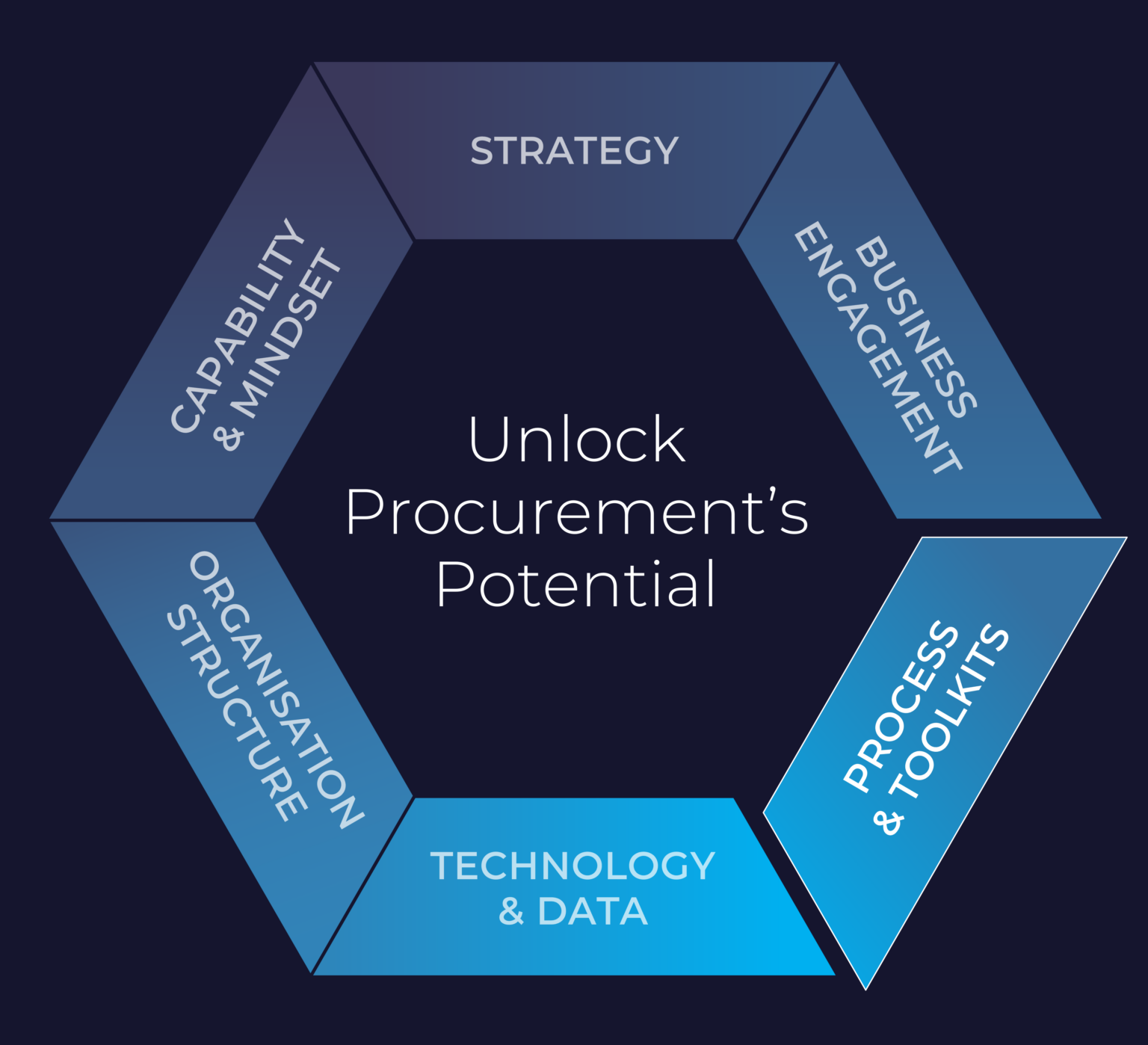
The Process dimension is built on three pillars:
- Capability Toolkits: Establishes integrated and high-quality tools for category, supplier, innovation, and risk management, ensuring they are accessible, consistently applied, and aligned with agreed quality standards. This provides the conceptual foundation – the business rationale, definitions (such as what Category Management means), and practical toolkits that enable effective execution.
- Process Documentation & Integration: Captures detailed process flows (often Levels 4 or 5 in a Business Process Management tool), process owners, the tools used, and the level of automation for each process. This includes integrating procurement processes with adjacent business processes such as S&OP, operational and design excellence, and ESG to drive cross-departmental alignment and clear process ownership that enable continuous improvement.
- Process Operationalisation & Improvement: Implements robust tracking, reviews, and reporting mechanisms to ensure compliance, performance, value delivery, and risk management. This establishes the structure for monitoring process execution, capturing insights, and driving continuous improvement through data and stakeholder feedback.
Why is it important?
Process provides the operational backbone that transforms procurement capabilities into consistent, measurable results. Without standardised, well-designed processes, even skilled teams with strong stakeholder relationships cannot deliver reliable outcomes or scale their impact effectively across the organisation.
Integrated tools and quality standards ensure that procurement activities consistently identify all available value opportunities, whether in category management, supplier relationships, or innovation initiatives. When procurement processes are designed, mapped, and integrated with broader business processes, procurement operates efficiently while maintaining the rigour needed for effective risk management and compliance, while also being ready to embrace automation, which can help increase efficiency and accuracy.
Most importantly, robust process frameworks enable continuous improvement and knowledge capture. Clear ownership, regular reviews, and stakeholder participation create accountability and learning loops that enhance performance over time or highlight opportunities for further simplification. This systematic approach distinguishes mature procurement functions that can deliver consistent value from those that rely solely on individual expertise – ensuring procurement’s contribution to business success is reliable, scalable, and sustainable.
How Process impacts other operating model dimensions
The Process dimension is strongly interconnected with every other operating model dimension, underscoring why getting this one right is so crucial. Your processes must directly support what procurement aims to achieve through its strategy – focusing on what is core and what drives the most value. Because an 8-step process is not aligned with the ambition to simplify.
Your organisational structure should reinforce this by assigning people to specific process areas, ensuring accountability and focus. Those people need to be trained and enabled to deliver processes effectively, while tools must support or automate execution. This creates a reinforcing cycle: well-defined processes guide capability development, which in turn drives better execution.
Importantly, processes must evolve as business requirements and technologies change. The Process dimension is not static – it adapts as your strategy shifts, your team’s capabilities grow, and new tools become available.
Why clarity and documentation define procurement maturity
Organisations often believe their processes are unique, yet few can show what truly differentiates them – mainly because their processes aren’t properly documented. This lack of clarity creates inefficiency and prevents organisations from learning best practices across industries.
Clearly defining business concepts and documenting process flows are hallmarks of leading procurement teams. It makes inefficiencies visible, highlights bottlenecks, and reveals where automation or redesign can create the most impact. Without this foundation, excellence remains out of reach.
Robust processes are the bedrock of procurement excellence. Clear process definitions reduce ambiguity, set expectations, and enable teams to execute consistently – regardless of individual expertise or experience levels. Standardisation doesn’t stifle creativity; it frees teams to focus on strategic value creation instead of reinventing the basics.
From definition to execution: Making processes work
Clarity in process design and documentation reduces ambiguity and enables efficient execution. Well-defined processes help people deliver effectively by setting clear expectations and standards, while also defining the requirements for the tools that support or automate them.
Process excellence requires continuous attention and improvement. As your procurement strategy evolves, your team develops, and new technologies emerge, your processes must adapt to remain relevant, efficient, and effective.
Of course, even the best-designed processes need the right tools to support them. Our next blog explores the Data & Technology dimension, where we’ll examine how digital tools, automation, and data analytics can amplify your procurement processes and unlock new levels of efficiency and insight.
Further reading in our procurement operating model series
- Why AI demands a procurement operating model rethink — and what it really means for your team
- Dimension 1: Strategy – Building your blueprint for success
- Dimension 2: Business Engagement – Elevating Procurement to a strategic partner
- Dimension 3: Process – Workflows that work
- Dimension 4: Data & Technology – Your Digital Advantage
- Dimension 5: Organisation Structure – Building teams that deliver
- Dimension 6: Capability & Mindset – Unleashing Team Potential
- Designing an AI-Native Procurement Operating Model > Download the white paper here

About Mark Webb
Managing Director
30+ years procurement experience in line management
and consulting roles.
Previous employment: Price Waterhouse, Mobil Oil and QP Group
Education: BSc in Management Science and MSc in Business by Research, Aston University
CIPS: Member