



Category Management
Procurement Category Management
What is Category Management in Procurement?
Category Management is a strategic, end-to-end process for buying goods and services. It organises spend into groups of related products and services, defined by their characteristics, market dynamics or business objectives. It manages each group so that business goals and customer requirements are aligned with what the supply market can offer, maximising long-term value for the organisation.
Category Management is a cross-functional activity. Teams from across the business work together to review category spend, define business needs, examine the supply market and suppliers, identify opportunities for savings and value improvement, and align procurement with the organisation’s wider goals.
Done well, Category Management makes Procurement strategic and moves it from transactional buying to sustained value creation by delivering lower costs, reducing risks, improving service levels, increasing revenue, and delivering stronger organisational performance.
Why does Category Management matter for unlocking a high-performing Procurement function?
Category Management sits at the core of Strategic Procurement. It connects internal requirements and the organisation’s wider strategic objectives to the eexternal supply market, allowing procurement to act as a strategic business partner that informs and guides decisions rather than playing a reactive and operational role.
It is a strategic capability that only delivers at scale when it is embedded across the wider Procurement Operating Model, from strategy and processes through to technology, organisation structure, and business partnering. Category Management depends on trained, capable people, which is why it draws heavily on ‘Capability and Mindset’ dimension. The technical, behavioural and digital skills category managers rely on are exactly the ones a structured Procurement academy is designed to build.
The return on getting this right is significant: Our own benchmark data from the Global Category Management Report indicates that organisations which fully optimise Category Management can achieve as much as €112m in savings per €1bn of spend once fully embedded, and an ROI greater than 500%. For a fuller picture, see our view on building a high-performing category management operation.
Exploring Category Management in Procurement
Category Management covers many angles and facets that matter for navigating the complexity of Procurement. We lay out how it differs from strategic sourcing, how to build category intelligence, which tools and technology support it, how to drive broad adoption, and the challenges ahead.
Category Management vs Strategic Sourcing
Category management and Strategic Sourcing are two sides of the same medal. They share many of the same steps, but they differ in subtle ways that significantly impact how each is applied.
Strategic sourcing is a procurement process built around sourcing events, selecting suppliers, and negotiating contracts to meet a specific requirement. It usually spans a one- to three-year horizon, with the primary aim being price and cost reduction through aggregation and consolidation. It needs limited business input beyond specifying the requirement, provides a snapshot of the external market, and improves how an organisation buys.
Category Management is broader on every axis. It is an enduring, cross-functional process that depends on intensive collaboration with business stakeholders to build deep insight into internal requirements, and it pursues wider business value across risk, revenue and innovation as well as cost, which can include buying less through demand management or buying smarter through specification management.
It brings deep internal and external expertise across product structure, supply chains, the supplier landscape and regulatory and risk factors, and it provides the governance to steer the organisation as an intelligent customer in what it buys. Rather than solving a single requirement, it sets the go-to-market approach for an entire category, often spanning several sourcing events, over a three- to five-year horizon.


Category strategy
A category strategy is the plan for how an organisation manages a category to deliver its business objectives. It is a business strategy for the category in its own right, addressing the many aspects of the business that surround the most effective acquisition and use of a set of products or services, rather than only how they are sourced.
A common mistake is treating a category strategy as a sourcing strategy. An excellent category strategy reaches well beyond the areas procurement controls directly. It considers a wide spectrum of value, from familiar levers such as leveraging price, through often-overlooked ones such as optimising the supply chain, to areas that rarely feature at all, such as reducing time to market for new products and services.
Above all, a category strategy should clearly link business strategy to action. It is a primary route for delivering critical parts of the organisation’s strategy, not simply a way to access a lower price. A goal such as net-zero carbon, for instance, translates through the category strategy into specific changes to specifications, supplier selection, supplier management, contracting and internal processes.
Category intelligence and value levers
Creating full value from a category strategies relies on category intelligence. Spend information is where it starts, but category intelligence is much more than a spend cube. It combines a clear view of what the organisation buys and from whom with insight into the supplier landscape, cost structures, supply markets, and the regulatory and risk factors that shape the category, so that the category strategy is built on genuine understanding rather than a last-minute search for data.
Intelligence only creates value when it is used to pull the full range of value levers. True excellence comes from category strategies that reach well beyond price and cost into risk reduction, sustainability, revenue and innovation, and this is where the ambition of a strategy shows. The best category strategies are wide-ranging and are genuine business strategies in their own right, while weaker ones default to a narrow set of familiar levers.


The Category Management Toolkit
A consistent, high-quality toolkit is what turns Category Management from an ad hoc activity into a repeatable process. Our Track8 procurement toolkit is a structured library of high-impact processes, flexible tools, and compelling summaries for each critical step in Category Management, Supplier Management, and strategic alignment.
Developed over thousands of hours across more than 200 client implementations and refreshed alongside our Global Category Management Report, the blueprints are fully flexible, so teams can adapt or supplement their established ways of working to make the tools their own. Every template is supported by clear how-to guides that double as a learning resource.
Technology increasingly enables and automates these tools, from spend analysis and market intelligence through to strategy development and execution planning. The aim is to digitally enable the process rather than bolt tools onto unchanged ways of working.
AI in Category Management
AI is starting to accelerate and change how category strategies are built as it supports elements of the toolkit. Its clearest gains are in the most time-consuming analytical work, from spend analysis and market intelligence to the first drafts of a strategy. What it does not do is remove the need for judgement. AI can produce output that is confident and still subtly wrong, so category managers need to know a category well enough to challenge what it gives them. Used well, AI supports expert judgement and increases the availability of high-quality category strategies.
Its most valuable contribution may be in decisions that have always been hard. Working out which combination of initiatives will deliver the most value for a category is usually done manually and coloured by recency, familiarity and opinion. AI can weigh business requirements against the available value levers and suggest the initiatives most likely to pay off, giving category managers a stronger, evidence-based starting point and freeing them to focus on strategy, stakeholder relationships, and innovation.


Category Management adoption
Category Management adoption is won or lost in the same place as every technology and transformation programme: change and enablement, not the method itself. According to Gartner, around 80% of digital transformation initiatives have historically failed to deliver the value promised, and the reason is rarely the tool or the process.
New ways of working are usually bolted onto an unchanged operating model. Enablement and training are cut when budgets tighten, and people only get taught to operate a tool or complete a template rather than build the capability that enables them to judge the output.
Breaking that cycle takes a deliberate plan for enablement and change. It requires redesigning the operating model around the new tools and ways of working, and building genuine capability. A category management maturity assessment gives you an honest benchmark on where you are, shows you which operating model changes will most improve adoption, and turns the identified opportunities into a prioritised roadmap.
Top tips for stronger category strategies
Category strategies hold immense potential, yet the evidence of genuine best practice often falls short on quality. From reviewing hundreds of strategies, we have distilled the habits that most reliably lift one from adequate to excellent.
A few stand out: present the strategy to a professional standard so it earns attention and approval, rigorously quantify and stress-test the benefits so the numbers hold up under challenge, and co-create it with stakeholders so it is owned by the business rather than imposed on it. For the full set, see our ten expert tips for stronger category strategies.

Sustainability in Category Management
Category Management is a practical route to embedding sustainability, because it turns broad sustainability ambitions into specific requirements and actions within category strategies. That means building the organisation’s existing sustainability commitments into category strategies, and turning high-level stakeholder objectives into changes procurement can actually influence.
In practice, the owner of the sustainability targets is usually a key stakeholder, and the category manager’s job is to articulate those requirements clearly within the category strategy. As with every other area, sustainability needs to be embedded across all six dimensions of the operating model rather than treated as a bolt-on. Our experience is that incorporating strong sustainability targets into category strategies is still in its early stages for most teams, making it a significant opportunity for those willing to lead.


Category Management and the supply chain
The value of category management does not stop at an organisation’s own spend. Driving category management down the supply chain means influencing supplier decisions across Tier 1, Tier 2 and the wider n-tier supply base. Done well, this extends the discipline’s benefits to cost, risk, ESG performance, and supply continuity. It helps organisations behave as an intelligent customer across the whole chain rather than only at the first tier, and it is where category strategies start to shape the resilience and responsibility of the supply base, not just its price.
Future challenges for Category Management
Category Management continues to face real constraints, and the most pressing are about people and process rather than tools. Skills and capability are a significant issue for a meaningful share of teams, and some category managers lack the time and space to apply their skills within a category environment. A limited or absent process is another common barrier, and rising supply chain risk and macroeconomic pressures such as inflation and supply shortages add further strain.
These challenges are addressable, but success is far more likely when a well-thought-out improvement plan is in place. Investing in knowledge management matters too, because expertise too often lives in individuals’ heads and desktops rather than in the organisation, which puts the return on training and coaching at risk when people move on.

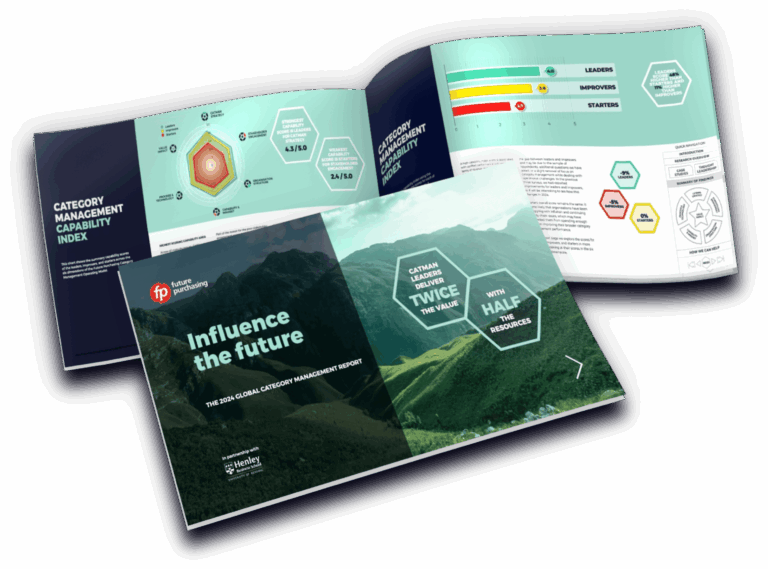
Global Category Management Report
Our Global Category Management Report is the largest benchmarking exercise for Category Management in Procurement – a holistic blueprint for what good looks like, combining research, focused summaries, and case studies. It sets out the techniques that drive the most value, helps you prioritise practices for closing the performance gap, and gives you guidance on how to design and build an effective category management programme.
Perform a maturity assessment
See how your function measures up against peers and the realities of AI. Our Category Management Maturity Assessment benchmarks your performance, turns the results into a prioritised roadmap, and shows you how much value is still on the table.