



Blog
Strategic Alignment in Procurement: From Strategy to Business Value
By Mark Hubbard |
Strategic business alignment turns strategy into shared priorities
Many procurement teams have a (category) strategy they are proud of. Few can point to a decision it actually changed.
That gap is a real problem we see quite often. The function has a clear ambition, a tidy set of objectives and a well-rehearsed value proposition. Category teams spot genuinely good opportunities, and stakeholders turn up to the planning sessions. Yet month after month, resources get consumed by urgent requests and whoever happens to shout loudest. The missing link is strategic business alignment.
‘Strategy’ and ‘Business Engagement’ are the first two dimensions of the Procurement Operating Model, and strategic alignment is the piece that connects them. Strategy defines direction while Business Engagement enables collaboration. Strategic alignment converts both into shared decisions and an executable portfolio of work.
Strategic business alignment is the process through which Procurement and the business translate strategy into shared priorities, agreed trade-offs, and an executable portfolio of work.
Get the connection right and Procurement and the business agree where to focus, what they will achieve together, and how limited resources will be spent. Get it wrong, and even the best strategy stays on the shelf, while stakeholder engagement becomes a run of pleasant but inconsequential conversations.
Strategy sets the direction, but it does not make the choices
Strategy is the first dimension of an effective Procurement Operating Model. It sets the direction, defines Procurement’s purpose, ambition, and value proposition. It agrees on how performance will be measured, and explains how the function will contribute to the wider organisation. That contribution should reach well beyond price savings, into resilience, growth, risk, sustainability, innovation and simply making the business easier to buy for.
What strategy does not do is tell you which categories, suppliers or initiatives to tackle first. Say your strategy makes resilience a priority. You still have to work out which supply markets carry the most exposure, where you can realistically intervene, and what to do first. Say it commits Procurement to supporting growth. You still have to find the business plans that depend on new suppliers, extra capacity, or faster sourcing. Say it leans harder into sustainability. You still have to pin down where the impact is concentrated and which interventions are actually achievable.
Strategy alone can’t make those choices, and Procurement cannot make them on its own. They call for close collaboration with the business, and that starts with engagement.
Engagement matters, but it is not the finish line
Business engagement is one of the most important aspects of Procurement. We need strong relationships, regular conversation, and a real understanding of what stakeholders are trying to achieve. Category and business teams cannot build anything relevant without them.
The purpose of business engagement is better joint decisions: Procurement and the business agreeing on what matters, what they will do, who will own it, and how success will be measured.
The trouble is that engagement often becomes the objective itself. We count the meetings, draw the stakeholder maps, and chase general buy-in for our plans. All of that can improve relationships, but having good relationships is not the same as alignment. Getting there takes more than goodwill and good relationships – it needs formal structure.
The Business Engagement dimension of the operating model provides this structure for effective stakeholder engagement. Senior sponsorship gives Procurement the mandate to challenge requirements and coordinate across functions. Communication builds a shared understanding of Procurement’s purpose. Collaboration and co-creation let both sides shape plans and priorities together. Clear service levels keep the day job from swallowing the strategic work whole.
This combination creates engagement built to last rather than being a one-off exercise filed away. It forms a living relationship with forums where shared decisions can be made and revisited.
None of this is as simple as asking stakeholders what they want. They see priorities through the lens of their own function, while Procurement brings an enterprise view of spend, supply markets, risk and cross-functional demand.
Real alignment asks both sides to challenge each other’s assumptions and make trade-offs, and that is the point where Procurement stops taking orders and starts acting as a business partner.
Strategic alignment: from intent to outcomes
With direction set by strategy and the machinery of engagement in place, strategic alignment is where the two turn into action. It is the structured process through which Procurement and the business convert strategic intent into an agreed portfolio of work, weighing the organisation’s priorities, category and supplier opportunities, market and risk developments, and the resources both sides can actually commit.
Most organisations have far more procurement opportunities than they can ever pursue. Nearly every major category holds savings potential, suppliers with development or de-risking needs, business users with urgent or strategic initiatives, and advancing regulatory, technology, or sustainability requirements.
In practice, it requires the most senior category group leaders to work with their relevant stakeholders eg R&D, Marketing, Operations etc. To review these opportunities on an aggregated level.
Trying to tackle everything at once leads to dilution: overloaded category managers, patchy stakeholder support, and strategies written but never implemented. The real work of strategic alignment is not to lengthen the list of opportunities but to channel multiple simultaneous conversations into broader category group strategies – typically 6-10. Strategic alignment is about choosing what to focus on and where to focus scarce capacity.
In practice, alignment runs as a chain, with each link depending on the one before it.
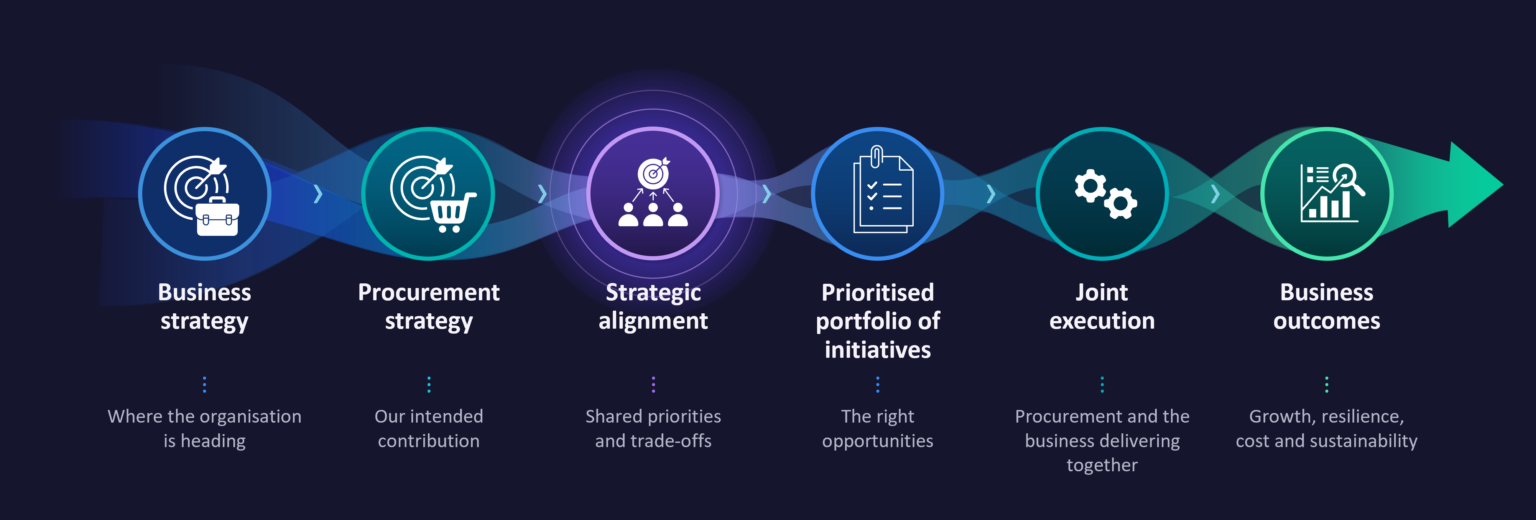
It begins with business strategy. Before Procurement commits to anything, it needs to understand where the organisation is heading: what it is trying to achieve, where it is investing, which capabilities are set to grow, where cost pressure is building, and what it has promised customers, regulators and investors. This is why we start with business priorities rather than the spend cube.
A large category is not automatically a strategic one, and a smaller one may prove critical to growth, continuity, or compliance. Clean category definitions help here, because a taxonomy built around real supply markets rather than budget lines is what lets important opportunities surface. That understanding shapes the procurement strategy: Procurement’s own priorities and intended contribution, set in response to the business rather than in isolation.
Alignment is the point where that direction meets the business itself. Through the engagement just described, Procurement and the business test each other’s assumptions, weigh competing demands, and agree where the effort should go (on category manager and senior leadership level). The result is shared priorities and explicit trade-offs: naming what will be done, and being just as clear about what will wait.
Those priorities become a portfolio of initiatives, whether category strategies, sourcing projects, supplier development, or risk and demand work. Each carries an owner, a business sponsor, the resources it needs, and a measure of success, and the sequencing is visible, so a smaller initiative with a willing sponsor and a clear run can rightly go ahead of a larger one that lacks data or market readiness. The aim is not the biggest number on paper, but the strongest portfolio the organisation can actually deliver.
The portfolio is then executed jointly, with Procurement and the business delivering together rather than Procurement working to a plan the business has forgotten it agreed to. And because conditions change, it is reviewed regularly rather than set once a year. Priorities shift, risks materialize, and new options appear, so continuous alignment means checking often that the portfolio still reflects the strategy and is executed as planned.
Done well, the chain ends where it should, in business outcomes: not sourcing events or savings counted for their own sake, but the growth, resilience, cost and sustainability results the organisation set out to achieve.
This is what makes strategic business alignment the connective tissue of the operating model across all layers of the organisation and seniority. Strategy, Business Engagement, and the other dimensions only create value when alignment points them at the outcomes the business is trying to reach. Get it right, and it stops being something Procurement delivers for the business, and becomes what Procurement and the business achieve together.
Turn procurement strategic business alignment into measurable action
A strategy only creates value when it shapes the decisions you make. We help procurement teams connect business priorities, category opportunities, and available resources to build a focused, deliverable portfolio of opportunities. And to build an operating model that keeps them aligned as conditions change.
Talk to us about strengthening your procurement strategic business alignment

About Mark Hubbard
Director
30+ years experience in procurement and supplier management, in line and consulting roles
Previous employment: Positive Purchasing Ltd, SITA,
QP Group, BMW, SWWS, Rover
Education: BSc in Engineering Metallurgy, MBA University of Plymouth
CIPS: Member
Further Reading



Whitepaper
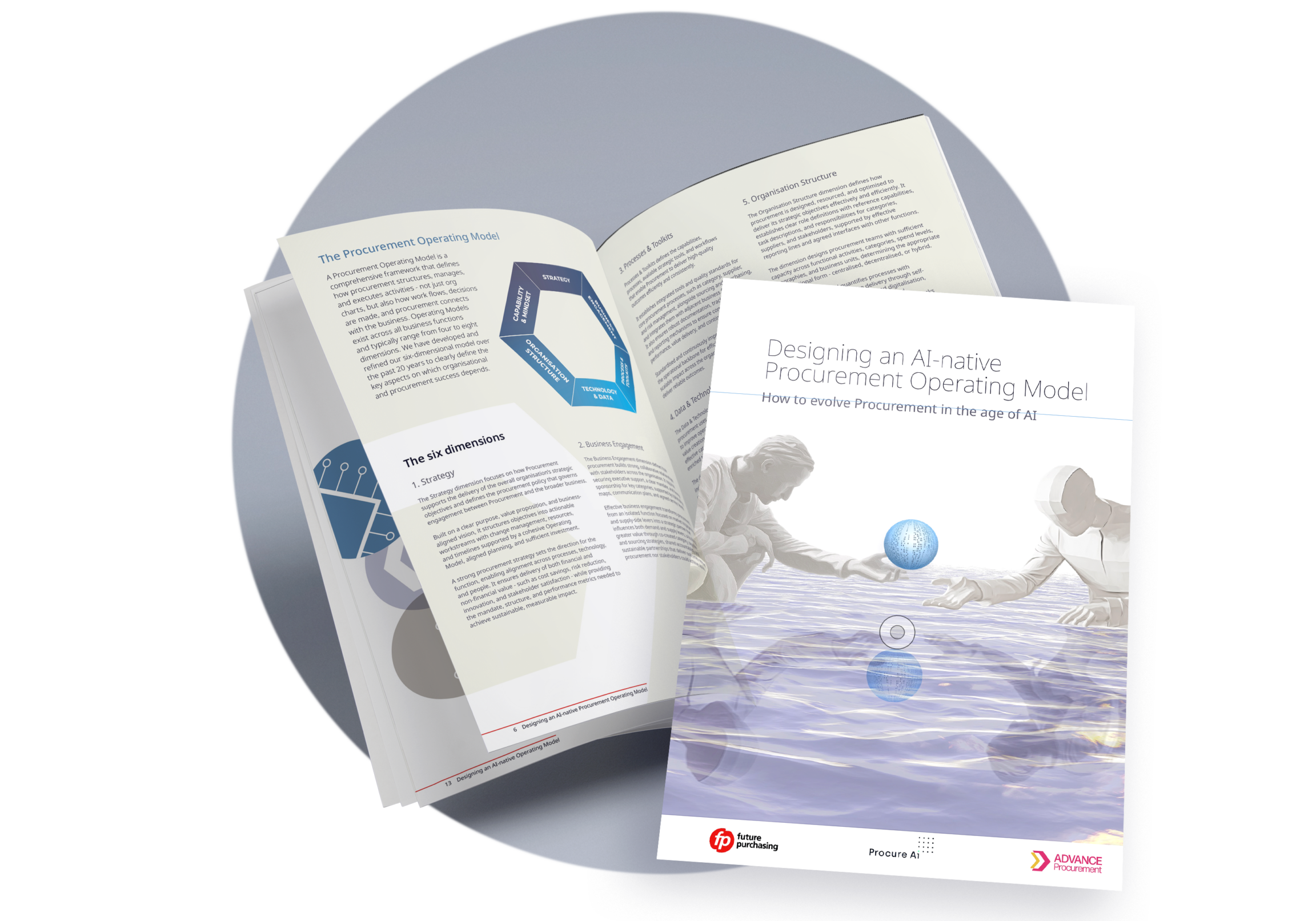
The AI-native Procurement Operating Model
By Future Purchasing |
Let’s Talk
If you want to get more value out of your procurement spend, or you just want to know more about us, request a callback above or send us an email and we will come straight back to you.
Further Reading
Video & Blog
Procurement skills in the age of AI: what it takes to thrive
By Mark Hubbard |
The AI-native Procurement Operating Model is not brought to life by technology. It is brought to life by people. That is not a comforting story we tell ourselves but a lesson from 20+ years of procurement transformations and a familiar pattern in the ones that fail.
In our recent webinar, Procurement skills in the age of AI, we brought together experts in operating model design, training, AI, and procurement transformation to go deep on one dimension of the Procurement Operating Model that decides whether the rest ever works: Capability & Mindset. This blog summarises how the skill landscape is shifting, which capabilities matter now, and how to manage the transition.
Start with the model, not the tool
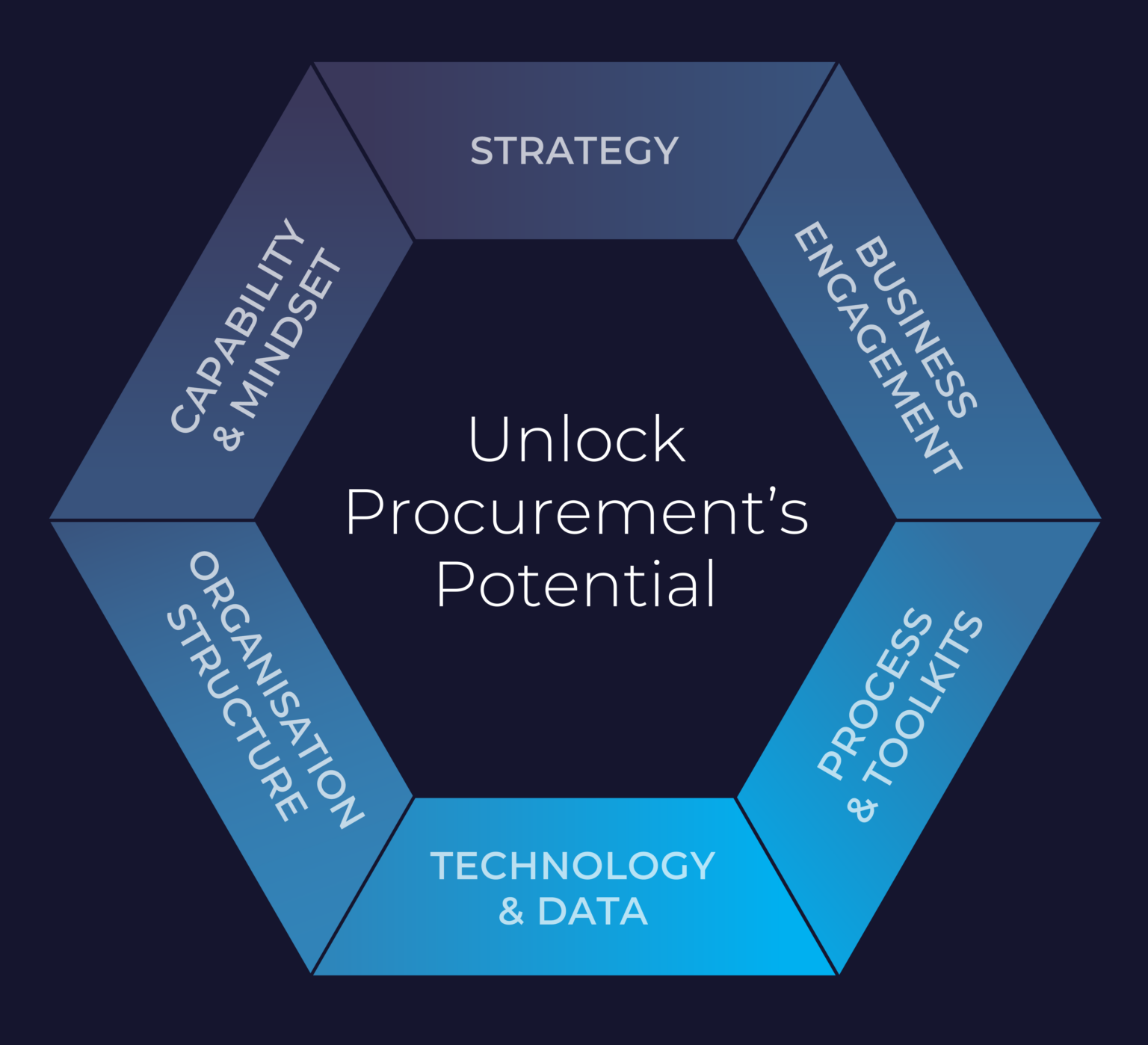
A Procurement Operating Model defines how procurement structures, manages, and executes its work. A Target Operating Model is not just about drawing org charts, but about defining how work flows, how decisions get made, and how procurement connects with the business. It spans six dimensions: Strategy, Business Engagement, Processes & Toolkits, Data & Technology, Organisation Structure, and Capability & Mindset.
AI touches every one of them. But the temptation to lead with the tool is exactly the trap. People remain a key dimension of every operating model, even the AI-native one. Before discussing skills for the age of AI, it is therefore essential to define (agentic) AI in Procurement.
A useful distinction from the webinar around agentic AI was that a chatbot talks, an agent does. Ask a friend for a restaurant recommendation and you have a chatbot; hand them your phone and say “book me a table for Friday” and they go check options, make the reservation, and confirm it is done – you have an agent.
An agent has tools, the autonomy to choose which to use, and a goal it works toward over multiple steps. The impact in procurement is already real: intake agents cutting order processing times, autonomous sourcing agents saving on tail spend, agents speeding up how teams run and evaluate an RFx. This is not future talk. It is happening now.
AI is redrawing the skills framework, not erasing it
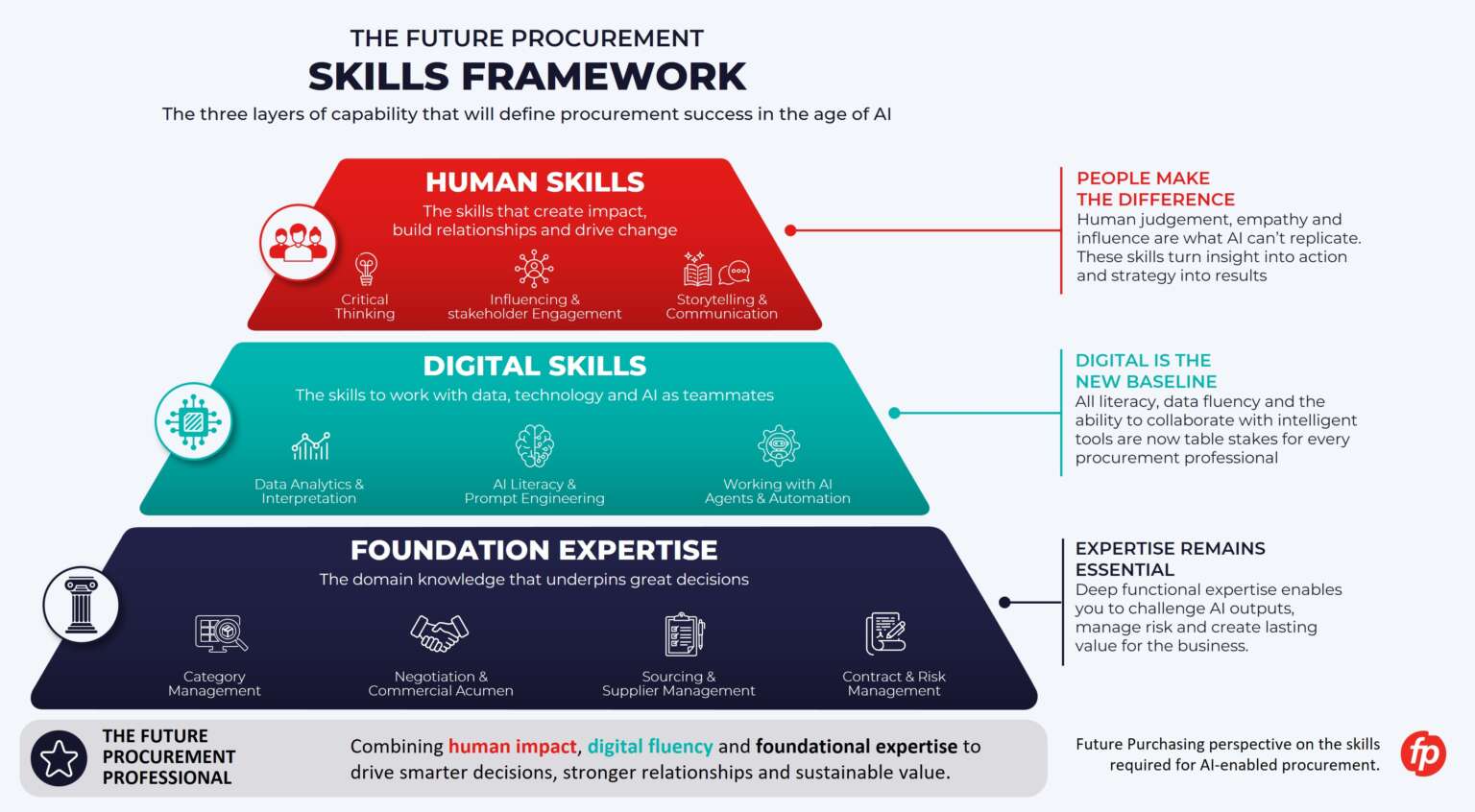
For years, procurement skills frameworks have grouped capabilities into foundational or technical skills on one side and soft or business-partnering skills on the other. Most real-world challenges draw on both, because getting change to stick across teams is as much a human task as a technical one. The important question now is not whether AI makes these skills obsolete. It is which parts of the framework AI enhances, which one it replaces, and which become more important than ever.
Three shifts came through clearly in the discussion:
- Soft skills become the real differentiator. Critical thinking, storytelling, and the ability to influence stakeholders and make things happen in real life. This is where humans add value no agent can replicate, and frankly, the part many teams have historically underinvested in.
We unpack the human and behavioural side of this in our companion pieces on the 10 key skills for successful category managers for 2026 and beyond and the importance of soft skills in Procurement.
- Digital skills are the new baseline. Data analytics, AI literacy, prompt & context engineering, and working with agents as teammates are no longer nice-to-haves but table stakes. Knowing how to interrogate AI, test for alternatives, and push for deeper follow-ups is itself a developing skill.
- Foundational skills stay foundational even when the tasks get automated. You still need to understand negotiation and category management deeply, because that is how you challenge an AI output and catch it when it is wrong. The tasks may be automated, the expertise cannot be.
The hard truth: productivity goes up, and that often means teams get smaller and roles change fast. It will not happen overnight, but the direction is clear. Procurement leaders deserve a candid picture rather than a comfortable one.
There is a real, unresolved challenge underneath this. Some expertise only comes from doing. If nobody runs a negotiation, manages a contract end-to-end, or works a sourcing process by hand, how do future practitioners develop the instincts to oversee those processes at all? As organisations automate, they have to be deliberate about how foundational expertise is built and preserved or risk a generation who can manage AI but not truly judge what it is doing on their behalf.
New roles, and a mindset that decides who thrives
As the framework shifts, new roles emerge: AI trainers, knowledge managers, AI system supervisors, and, anchoring all of it, the Procurement Technology Platform and Automation Owner, or ProcureOps. That is the role that grows in importance as AI scales rather than shrinks.
Leadership itself does not change dramatically in purpose, but leaders will have to know better how to orchestrate systems of people, agents, and platforms. This requires genuine AI fluency and ethical oversight.
The Mindset moves therefore from a soft preference to an in-or-out criterion. The environment rewards openness to AI, a willingness to experiment, and a commitment to continuous learning. People with that growth mindset thrive in a high-trust, high-impact function built on interconnected systems and fewer FTEs. It is less about aptitude on day one and more about the appetite to keep learning.
Technology adoption still follows capability – or implications for change management
One idea from the webinar is worth deeper contemplation. For twenty years, we bent people to fit systems: you bought an ERP or a S2P suite, and change management meant months of training humans to navigate screens the system dictated.
Modern AI and automation tools often don’t require tool enablement as they meet people where they are, meaning you talk to them in plain language and they adapt to how you work, or fully automate processes and thereby change the role/task of the person. Either way, the old adoption barrier, “I don’t know how to use it,” is shrinking fast.
The notion of “tool enablement” points directly at the core of the problem: people were trained to navigate the tools, not to learn the underlying process or rationale. With AI, people need to answer questions like ‘Can I rely on the output?’ or ‘When should I challenge it?’ – and they are not answered by any training manual.
The practical path to broad adoption is to invest in digital and AI literacy next to the functional and tool training. People who understand the process they try to automate and how AI works trust it appropriately: neither blind faith nor blanket resistance.
Why literacy, not awareness: teams are aware of AI, but awareness isn’t literacy. Being AI-literate means understanding how the models work, what data they need, and where the risks sit so you can challenge outputs, spot data issues, and use AI responsibly and with confidence. That is what turns procurement from a passive consumer of technology into a strategic user of it.
Where this leaves you
The skills required to succeed in procurement are evolving faster than ever. Foundational expertise still matters, arguably more, because it is what lets you hold AI to account. But it is no longer enough on its own. The teams that will thrive are the ones that sharpen their digital skills, invest hardest in the human ones, and build the mindset to keep adapting as the tools improve. None of that is a quick fix, and we would not pretend otherwise. It is deliberate work. Exactly the kind of work that unlocks procurement’s potential.
That doesn’t make change management easier. It changes what it’s about: no longer teaching clicks, but building capability, trust, and judgment.
The webinar goes deeper than any summary can, with Fabian Lampe, Mark Hubbard, and Konstantin working through the roles, the skills framework, and the new change management reality in detail.
How Future Purchasing can help
With 25 years of experience designing, implementing, and enabling procurement operating models, we train procurement teams to build sustainable capabilities. Our deep functional and hands-on expertise combined with practical and outcome-centric training and change management support makes you ready for AI in Procurement.
To go deeper into the impact of AI on the Capability & Mindset dimension, here are some free materials:
- Watch the webinar. See the full conversation on how AI is reshaping procurement roles and skills.
- Read the whitepaper. Our strategy paper on Designing the AI-native Procurement Operating Model explores the wider design question in depth.
- Build the capability. Procure Ai’s Procurement Aicademy is a free programme of short, practical videos taking teams from the technical foundations of AI through to applications in sourcing, negotiation, spend analytics, and data governance – ending in a Certificate of AI Literacy.
Get in touch if you’d like to talk through what this means for your function specifically. From assessing your team’s current maturity to designing the right learning pathways, our focus on designing training programs that unlock Procurement’s potential is what we thrive on.
Further reading in our procurement operating model series
- Why AI demands a procurement operating model rethink — and what it really means for your team
- Dimension 1: Strategy – Building your blueprint for success
- Dimension 2: Business Engagement – Elevating Procurement to a strategic partner
- Dimension 3: Process – Workflows that work
- Dimension 4: Data & Technology – Your Digital Advantage
- Dimension 5: Organisation Structure – Building teams that deliver
- Dimension 6: Capability & Mindset – Unleashing Team Potential
- Designing an AI-Native Procurement Operating Model > Download the white paper here
- Procurement operating model in the age of AI
About Mark Hubbard
Director
30+ years experience in procurement and supplier management, in line and consulting roles
Previous employment: Positive Purchasing Ltd, SITA,
QP Group, BMW, SWWS, Rover
Education: BSc in Engineering Metallurgy, MBA University of Plymouth
CIPS: Member
Further Reading


Video & Blog
Why AI demands a procurement operating model rethink — and what it really means for your team
By Mark Webb |
Procurement has never had more technology at its disposal. Over the past 30 years, ERP, P2P, sourcing platforms, and spend analytics have transformed the digital landscape. And yet, despite genuine progress, the step-change in strategic impact that many CPOs are seeking has remained frustratingly out of reach. We believe that AI represents a genuine opportunity to change that — but only if procurement functions are willing to do something that has historically proved difficult: redesign how they operate, not just what tools they use.
In our recent blog series, we explored all six dimensions of our Procurement Operating Model and what it takes to build a high-performing procurement function. But as we noted at the close of that series, AI is now changing and challenging every one of those dimensions.
To fully explore what that really means, we partnered with Procure Ai, a provider of custom built AI agents for Procurement, to develop a comprehensive whitepaper on designing a truly AI-native Procurement Operating Model. Here’s what we found, and what it means for you.
Getting the foundations right
Many procurement functions making their first moves with AI find themselves falling into one of three familiar traps:
- Running isolated pilots without a clear view of the organisational changes needed to scale.
- Treating AI as an add-on rather than a reason to rethink existing processes entirely.
- Assuming the operating model can evolve incrementally, when the pace of AI development demands something far more deliberate.
The result is a pattern that will feel recognisable: technology invested in, ways of working left unchanged, results that underwhelm.
Part of the problem is a misconception we see repeatedly: procurement teams equating an operating model with an org chart. They reshuffle roles, redraw reporting lines, and restructure teams, only to find that nothing fundamentally changes. An operating model is far broader than that. It defines how procurement creates value, how decisions are made, how work flows, and how the function connects with the wider business.
What’s needed isn’t simply tweaks to the org chart. It’s a holistic redesign of how strategy, processes, technology, and people work together — in that specific order. Strategy sets the vision. Processes define how work gets done and where AI operates. Technology enables execution. Only then can you determine the people needed, what they’ll do, and the skills they need.
Here’s a short insight into what that redesign looks like across each of the six dimensions of our Procurement Operating Model, and what AI changes in practice:
- Strategy must account for AI in two ways: the vision needs to consider what AI makes possible, and governance must establish guardrails for how agents operate. At the same time, execution shifts too — from annual planning cycles to continuous, always-on performance management.
- Business Engagement changes in character without losing its human core. Building trust, influencing decisions, and bringing stakeholders on the transformation journey are things no AI agent can do. What AI enables is more continuous and targeted engagement through automated alerts and embedded intake management.
- Processes and Toolkits must be reimagined for simplicity and rebuilt with AI-human collaboration at their core — not as an afterthought, but by design. As AI capabilities evolve, the boundary between human and automated work will keep shifting.
- Data and Technology shifts fundamentally in how it is valued. Data moves from an unloved byproduct of transactions to the foundation for automated processes and decisions, with integration between tools becoming the critical enabler.
- Organisation Structure changes not just in size but in nature. Roles shift from doing the work to orchestrating outcomes, with capacity planning now accounting for both human teams and AI agents.
- Capability and Mindset must keep pace. Digital skills become a fundamental requirement, but a deep understanding of procurement fundamentals remains essential — not despite AI, but because of it. You need to know what good looks like in order to judge whether an agent is delivering it.
These dimensions are deeply interconnected. Getting that redesign right — across all six, in the right sequence — is what separates AI initiatives that scale from those that stall.
The team size conversation you should be having
There is a tendency in the industry to acknowledge that AI will change procurement roles without being willing to say by how much. The honest answer is that the impact on team size will be significant, and procurement leaders deserve a clearer picture.
In our whitepaper, we did the calculation, and the results are compelling enough that every procurement leader should be asking these questions:
- What happens to operational buying roles as autonomous agents take over demand intake, purchase order creation, and routine supplier coordination?
- Will AI stop at transactional tasks, or does its reach extend into category management and strategic procurement?
- What new roles emerge as AI adoption scales, and where do they sit in the function?
The answers to these questions aren’t cause for alarm. They are an opportunity to build a leaner, more strategically powerful function. But they do require honest planning now rather than later, and a clear view of what the future procurement team actually looks like in practice.
That’s precisely what the whitepaper sets out.
How Future Purchasing can help
With 25 years of experience designing and implementing procurement operating models, we help procurement functions move beyond the pilots and build operating models that are genuinely fit for an AI-enabled world. Whether you’re at the start of that journey or looking to accelerate it, we combine deep functional expertise with practical, hands-on transformation and change management support, helping you redesign the right dimensions, in the right sequence, at the right pace for your organisation.
If you’d like to talk through what this means for your function specifically, get in touch with our team.
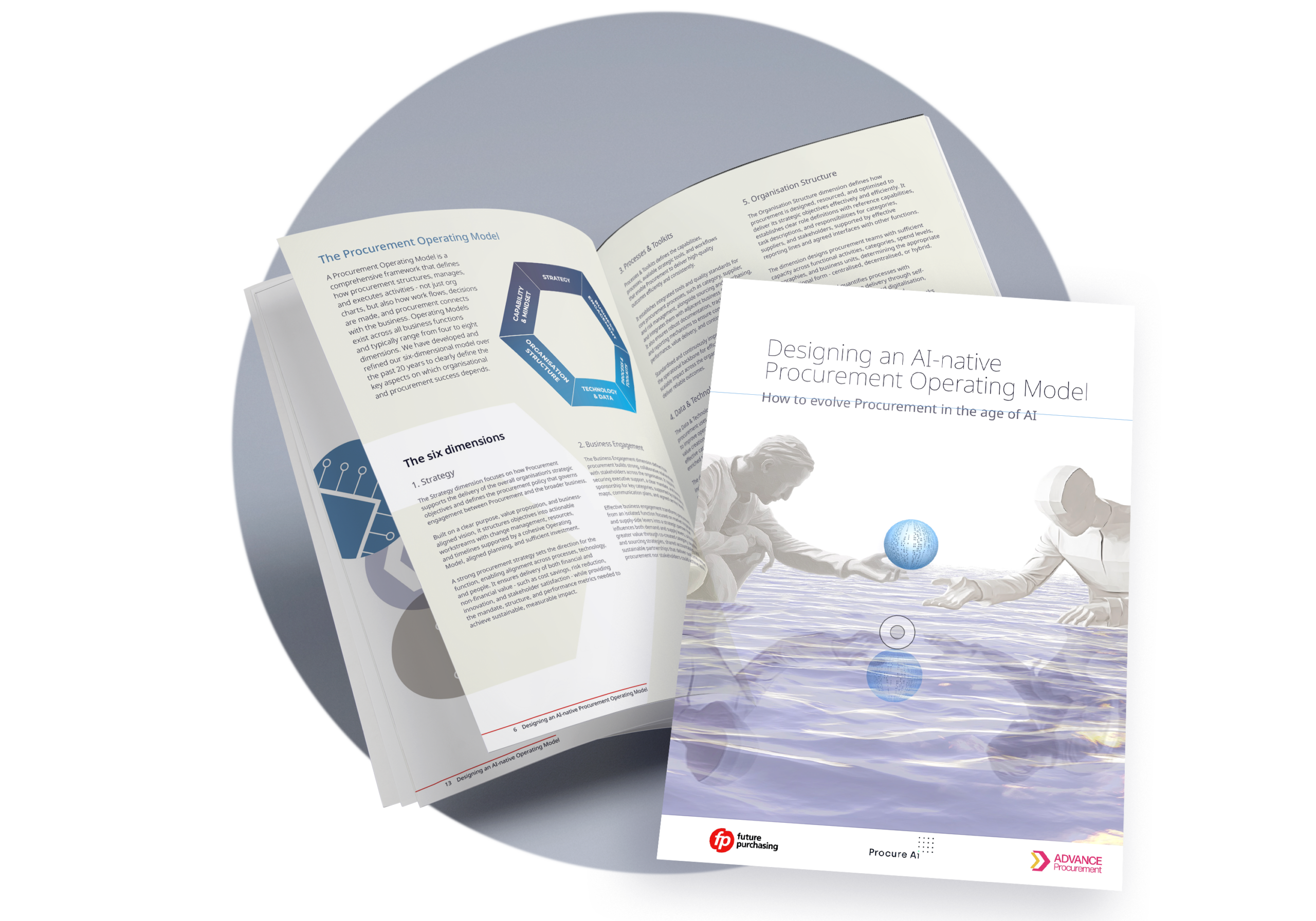
Our whitepaper, Designing an AI-Native Procurement Operating Model, goes deeper on all of this.
It covers how each of the six dimensions needs to evolve, the specific impact of agentic AI on procurement team size and role composition, the three distinct levels of AI integration in operating models and what separates them, and a practical framework for sequencing the transformation.
Further reading in our procurement operating model series
- Why AI demands a procurement operating model rethink — and what it really means for your team
- Dimension 1: Strategy – Building your blueprint for success
- Dimension 2: Business Engagement – Elevating Procurement to a strategic partner
- Dimension 3: Process – Workflows that work
- Dimension 4: Data & Technology – Your Digital Advantage
- Dimension 5: Organisation Structure – Building teams that deliver
- Dimension 6: Capability & Mindset – Unleashing Team Potential
- Designing an AI-Native Procurement Operating Model > Download the white paper here

About Mark Webb
Managing Director
30+ years procurement experience in line management
and consulting roles.
Previous employment: Price Waterhouse, Mobil Oil and QP Group
Education: BSc in Management Science and MSc in Business by Research, Aston University
CIPS: Member
Further Reading

Blog
Dimension 6: Capability & Mindset – Unleashing Team Potential
By Mark Webb |
You can have the most brilliant procurement strategy and design the perfect organisational structure, but without the right people, the right skills, and the right culture, it won’t deliver results.
This is why Capability & Mindset – also known as the people dimension – is so critical to Procurement success. While often overlooked and underinvested in, this dimension directly enables all other dimensions of your operating model to come to life.
Capability & Mindset speaks to procurement professionals’ inner drive for knowledge and advancement, making it a powerful component of the operating model. This blog outlines the elements of the Capability & Mindset dimension and how investing in people can help you unlock Procurement’s full potential.
What is the Capability & Mindset dimension?
Capability & Mindset focuses on developing the people, skills, and culture needed to deliver procurement excellence.
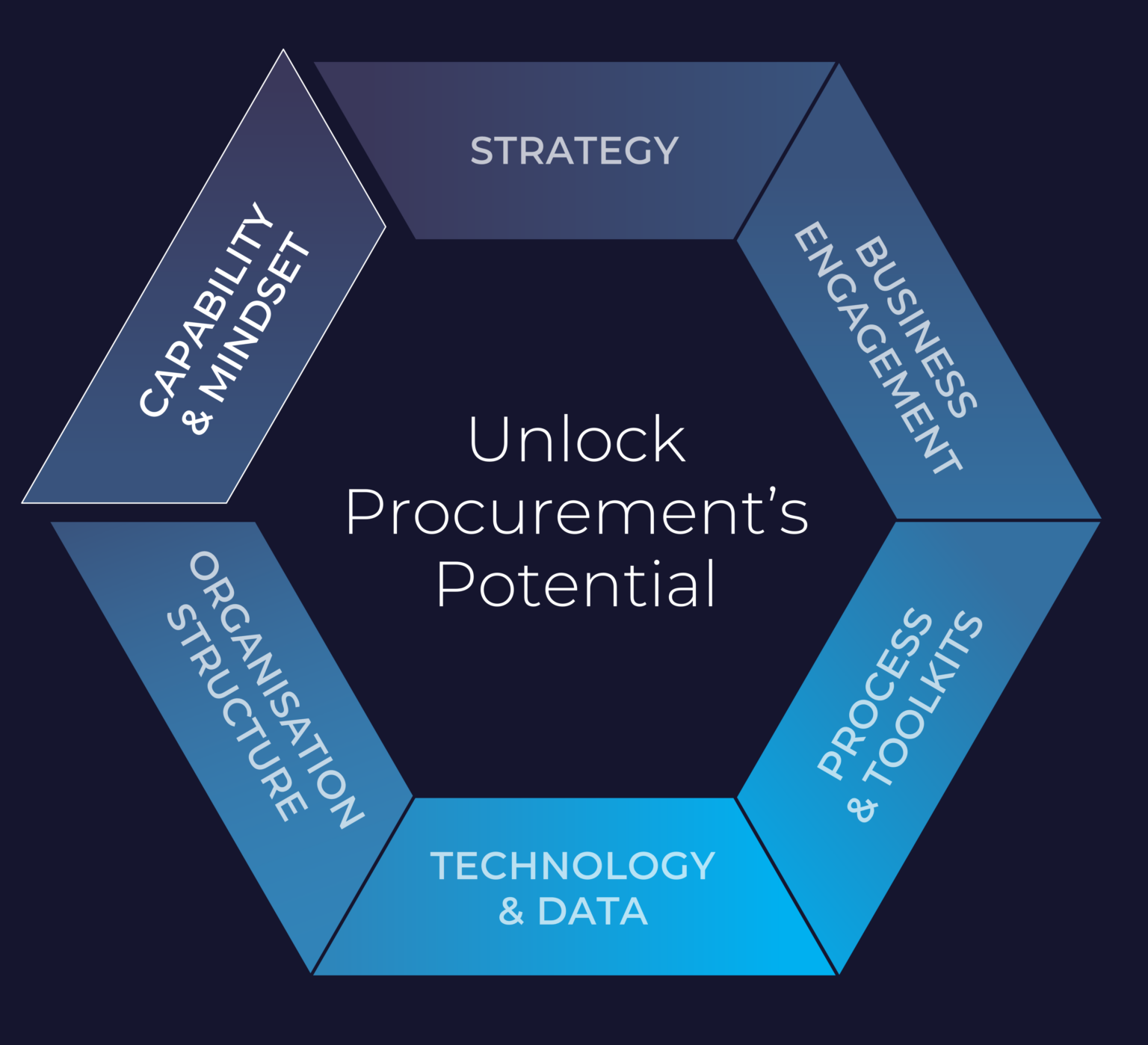
Capability & Mindset is built on five pillars:
- Leadership: Establishes strong and supportive role models that create a strong sense of identity and alignment with Procurement’s purpose. This includes ensuring aligned and consistent leadership that empowers the team and genuinely commits to people development.
- Capabilities: Defines well-structured competency frameworks detailing technical, digital, and behavioural skills required to perform processes, business engagement, strategic toolkits and technology & data to create excellent outcomes.
- Mindset: Fosters a culture of passion, urgency, and drive for high performance across the team, creating an environment where people are motivated to deliver exceptional results and contribute to the function’s success.
- Learning: Creates individual development plans aligned to competency frameworks and career pathways, implements structured learning programmes across all grades, and builds line manager coaching capabilities. This includes ensuring team members have excellent technical skills and experience in their specific areas of focus, the right mindset and behavioural skills to influence stakeholders, and formally managing knowledge sharing across the team to ensure continuous learning and improvement
- Development: Implements recruitment and retention strategies, establishes, and creates formal job profiles and clearly communicated career pathways to support professional growth
Why is it important?
Capability & Mindset is the critical enabler that transforms procurement strategy and structure into tangible results. Without the right skills, behaviours, and culture, even well-designed Procurement functions cannot deliver on their strategic objectives or build the stakeholder relationships necessary for success.
Technical expertise and the strategic application of tools are fundamental for creating compelling category or supplier strategies and data-driven insights that influence business decisions. Equally important are the behavioural skills and mindset that enable procurement professionals to collaborate effectively, tell compelling stories, and drive change across the organisation.
Most critically, a strong capability framework supported by structured development programmes ensures Procurement can adapt to evolving business needs and maintain high performance standards. When combined with effective leadership, clear career pathways, and a culture of continuous learning, this dimension creates a self-reinforcing cycle where skilled professionals deliver exceptional results, attract top talent, and build Procurement’s reputation as a strategic business partner. This foundation of capability and culture distinguishes high-performing Procurement functions from those that struggle to demonstrate value.
How Capability & Mindset impacts other operating model dimensions
Capability & Mindset is the dimension most connected to all other dimensions in your operating model. Your strategic objectives directly inform the capabilities you need to develop. Processes and tools require specific capabilities to operate effectively, and business engagement requires the interpersonal skills that this dimension builds.
Equally important is the constant alignment between roles and capabilities. As Procurement’s strategic role evolves, capabilities must evolve with it to ensure your organisational structure can deliver as intended. This dynamic relationship means ongoing investment in people development is essential, not optional.
People as a strategic asset
The people dimension is often treated in isolation from procurement strategy, despite the clear connection between building capabilities and delivering performance. This is a mistake.
Over the past 25 years, we’ve observed that people trained early in their careers are now often in senior leadership roles, bringing their knowledge and capabilities directly into strategic decision-making. This demonstrates the profound return on investment that people development delivers – not just in immediate performance, but in building a leadership pipeline and procurement culture that sustains excellence over time.
Training has evolved significantly, shifting from focusing solely on functional capabilities to encompassing the behavioural skills needed for business engagement, as well as the digital skills required in today’s procurement environment. This evolution reflects the reality that procurement excellence requires more than technical knowledge—it requires a mindset of continuous learning, adaptability, and a genuine drive to add value to the business.
Moving forward: Investing in your people in the age of AI
Of all the dimensions in your operating model, Capability & Mindset may be the most interconnected. Investing in people development is key to sustainably increasing team capabilities and unlocking Procurement’s full potential. The ability to perform designed processes and continuously improve them relies on people understanding them in light of your overarching strategic objectives – not just executing them mechanically.
As we’ve explored throughout this series, all six dimensions of the procurement operating model – Strategy, Business Engagement, Process, and Data & Technology, Organisation Structure, Capability & Mindset – work together to create a cohesive, high-performing function. And while these foundations are solid, the evolution of AI is changing and challenging Procurement, thereby decreasing or increasing the importance of individual components of the model.
In our next blog, we’ll discuss the impact of AI on the procurement operating model and what it means for the function’s future.
Further reading in our procurement operating model series
- Why AI demands a procurement operating model rethink — and what it really means for your team
- Dimension 1: Strategy – Building your blueprint for success
- Dimension 2: Business Engagement – Elevating Procurement to a strategic partner
- Dimension 3: Process – Workflows that work
- Dimension 4: Data & Technology – Your Digital Advantage
- Dimension 5: Organisation Structure – Building teams that deliver
- Dimension 6: Capability & Mindset – Unleashing Team Potential
- Designing an AI-Native Procurement Operating Model > Download the white paper here
About Mark Webb
Managing Director
30+ years procurement experience in line management
and consulting roles.
Previous employment: Price Waterhouse, Mobil Oil and QP Group
Education: BSc in Management Science and MSc in Business by Research, Aston University
CIPS: Member
Further Reading

Blog
Dimension 5: Organisation Structure – Building teams that deliver
By Mark Webb |
Organisation Structure is critical to procurement’s ability to deliver value. It determines how efficiently resources are allocated and therefore how effectively teams can deliver on strategic commitments and whether the function can operate with the clarity and coordination needed to drive meaningful business impact.
But while organisational structure is crucial, it is only one dimension of a comprehensive operating model. This is where many Procurement Teams go wrong. They equate organisational structures with the overall Procurement operating model. They redesign org charts, reshuffle roles, and implement new reporting lines -only to discover that restructuring alone doesn’t transform the function. For true transformation to take place, organisational structure must be aligned with the other dimensions like strategy, processes, business engagement, and capability building.
This blog outlines the elements of the Organisation Structure dimension and how they connect with other dimensions of the operating model to create a cohesive, effective procurement function.
What is the Organisation Structure dimension?
The Organisation Structure dimension defines how procurement is designed, resourced, and optimised to deliver its strategic objectives effectively and efficiently.
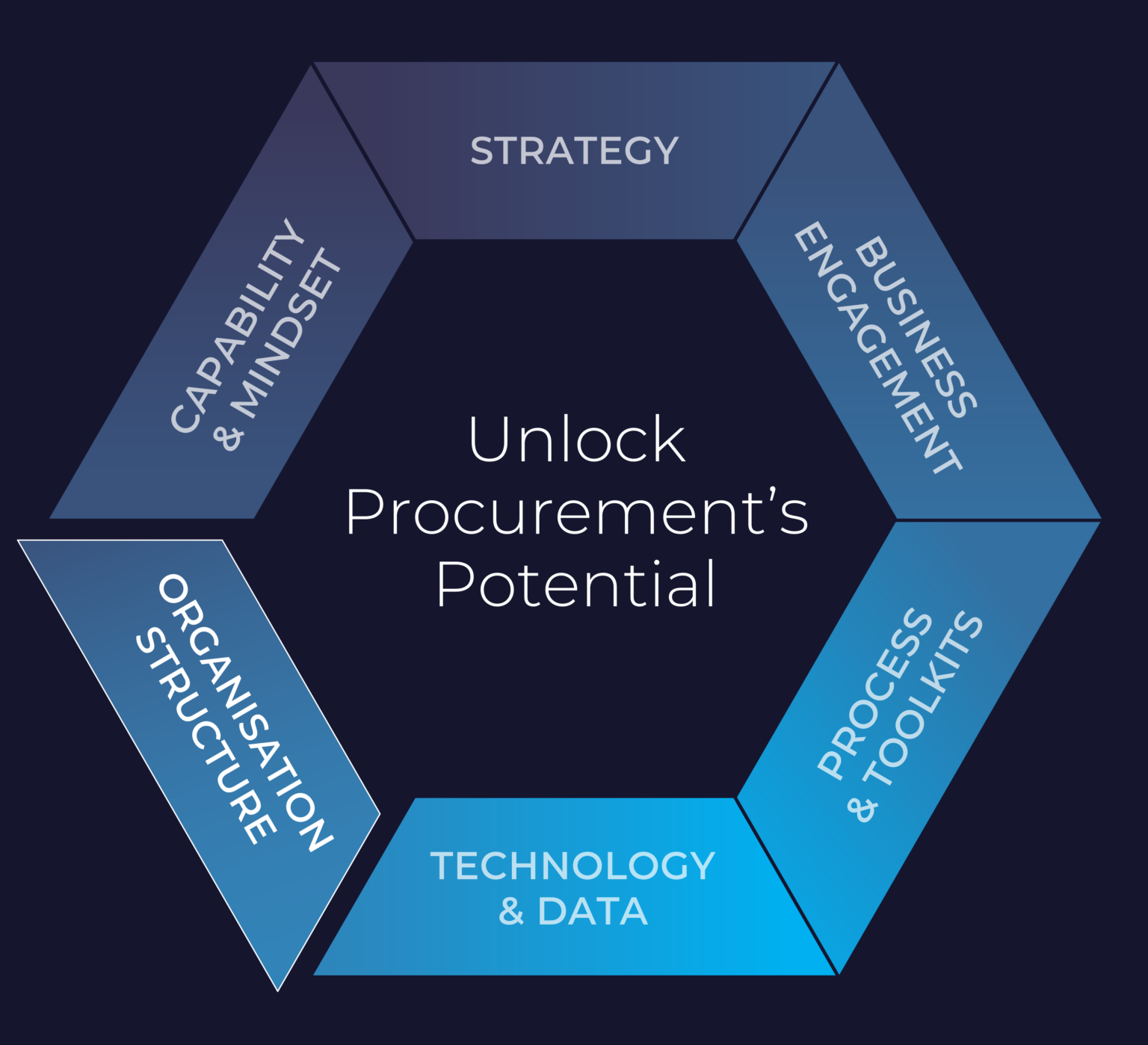
The Organisation Structure dimension is built on three pillars:
- Roles and Responsibilities: Establishes clear role definitions with reference capabilities, task descriptions, and responsibilities for categories, suppliers, and stakeholders across the organisation. This includes defining interfaces with other functions that are clear and agreed upon, as well as establishing effective reporting lines.
- Team Structure: Designs procurement teams with sufficient capacity for functional activities, categories, spend levels, geographies, and business units. This includes determining the appropriate organisational form – whether centralised, decentralised, or hybrid – and may include establishing Procurement Centres of Excellence.
- Activity Optimisation: Documents and quantifies procurement processes with time requirements, ensuring team workload capacity is up to date. This enables optimisation through various delivery models and technologies, including self-service, outsourcing, automation, and digitalisation.
Why is the Organisation Structure dimension important?
Organisation Structure determines Procurement’s capacity to deliver on its strategic commitments and directly impacts the function’s effectiveness and efficiency. Quantified processes and optimised delivery models ensure Procurement operates efficiently, with organisational design reflecting desired strategic priorities and preventing resource bottlenecks. Without proper organisational structure, developing and executing stakeholder relationships remains opportunistic and tactical, making their translation into valuable initiatives and activities ineffective.
Most critically, well-defined roles and responsibilities eliminate confusion and duplication of effort across the organisation. When interfaces within Procurement and with other functions are clear and cross-functional steering groups provide appropriate oversight, procurement can operate with the authority and coordination needed to drive meaningful change and deliver on its strategic priorities.
How Organisation Structure impacts other operating model dimensions
Organisation Structure must be built around the strategic direction, objectives, and governance principles established in the Strategy dimension. Roles & responsibilities are a direct derivative of the desired processes and ways of working, reflecting the interdependencies between them.
The team structure must also support the expectations towards business engagement. If Procurement has committed to co-creating strategies with stakeholders or providing dedicated category management, the organisational design must allocate sufficient resources or create roles that support these engagement models.
Lastly, the organisational structure works in tandem with the people dimension – roles require specific capabilities to perform tasks effectively, so there’s a strong connection to building the right skills and capabilities within teams.
Why endless reorganisations miss the mark
Here’s what we see repeatedly: organisations undertake structural redesigns that almost never have time to settle in before the next one begins. Why? Because they’re simply moving names on org charts instead of transforming the function.
Limiting discussion to org charts is a clear signal that transformation will fail. Without alignment to strategy, business engagement needs, and capability development, the reorganisation just rearranges deck chairs. The next restructuring will arrive within months when leadership discovers that the new structure didn’t solve the underlying performance issues.
The organisations that succeed view org models as an interconnected part of the overall operating model, where all pieces need to align to achieve the desired results. Structure isn’t the starting point—it’s the outcome of having clarity on strategy, engagement approach, processes, and capability requirements.
Getting it right: Structure as a reflection of strategy
Organisation structure matters, but it’s really a reflection of the role procurement wants to play and the value it wants to deliver, of its vision and ambition. It’s the physical manifestation of your strategic vision and engagement model.
Most teams get this upside down – starting with organisational design and then wondering why they don’t deliver the expected results. The right approach is to start with strategy, define how the business should be engaged, define the processes and supporting tools required, and then, and only then, design an org structure that can actually deliver on those commitments.
The missing piece for many organisations is capability and mindset. Even the best organisational design will underperform if the team lacks the skills, leadership approach, and cultural foundation to execute effectively.
Our next blog explores Dimension 6: Capability & Mindset—the people element that brings your operating model to life and determines whether your structure actually delivers the strategic value you’ve envisioned.
If you want to learn more about how we help determine suitable roles & responsibilities and build strong org models, talk to us about our Compass tool.
Further reading in our procurement operating model series
- Why AI demands a procurement operating model rethink — and what it really means for your team
- Dimension 1: Strategy – Building your blueprint for success
- Dimension 2: Business Engagement – Elevating Procurement to a strategic partner
- Dimension 3: Process – Workflows that work
- Dimension 4: Data & Technology – Your Digital Advantage
- Dimension 5: Organisation Structure – Building teams that deliver
- Dimension 6: Capability & Mindset – Unleashing Team Potential
- Designing an AI-Native Procurement Operating Model > Download the white paper here
About Mark Webb
Managing Director
30+ years procurement experience in line management
and consulting roles.
Previous employment: Price Waterhouse, Mobil Oil and QP Group
Education: BSc in Management Science and MSc in Business by Research, Aston University
CIPS: Member
Further Reading

Blog
Dimension 4: Data & Technology – Your Digital Advantage
By Mark Webb |
Data and technology are powerful enablers to drive efficiency and impact in procurement. Modern procurement functions have many solutions at their disposal – ERPs, Procurement Suites, AI platforms, specialist solutions, data providers, and more. But having access to and buying technology isn’t enough.
The challenge lies in carefully orchestrating which tools support which processes or objectives, and in embedding them effectively within your procurement landscape. Procurement needs to understand not just what technology can do, but how it fits within the broader operating model to deliver its promised value.
This blog outlines the elements of the Data & Technology dimension and explains why aligning technology investments with your operating model is essential to getting any value out of them.
What is the Data & Technology dimension?
The Data & Technology dimension defines how Procurement uses information assets, digital tools, and AI to improve operational efficiency, process accuracy, and value creation.
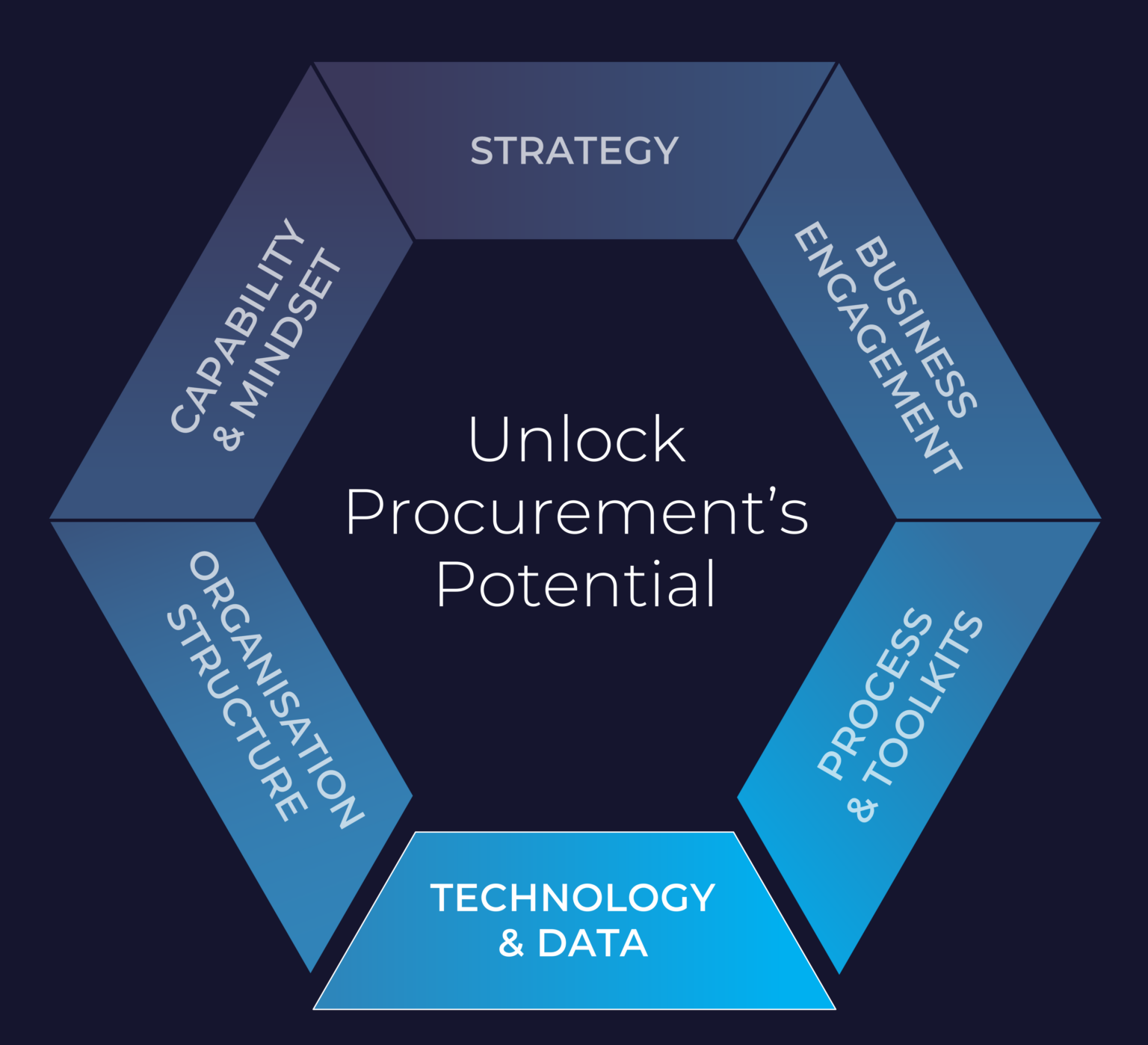
The Data & Technology dimension is built on five pillars:
- Data: Establishes a clear data strategy underpinned by an effective category taxonomy structure to ensure accurate, up-to-date spend data, enriched with reliable third-party supplier data and external sources.
- Tools & Technology: Digital capabilities across the end-to-end procurement process that support the execution and automation of defined processes in alignment with strategic objectives and compliance requirements. This includes ERPs, Procurement Suites, AI platforms, third-party data providers, or specialist solutions for Spend Analytics, Category Management, Market Intelligence, Supplier Relationship Management, Sourcing, Negotiations, Contract Lifecycle Management, Risk Management, Intake Management, or Purchasing.
- Innovation: Structured approach for actively identifying (scouting), testing (piloting), and implementing (scaling) innovative technology solutions (also possible for other areas) that enhance procurement efficiency and impact, ensuring the function stays current with emerging digital capabilities and AI advancements.
Why is it important?
Data & Technology serves as the enabler that amplifies procurement’s impact while reducing manual effort and increasing accuracy across all activities. Without robust data foundations and effective technology adoption, Procurement teams spend disproportionate time on administrative tasks rather than strategic value creation.
Accurate spend data and effective taxonomy structures provide the analytical foundation for informed category strategies and decision-making, enabling procurement to identify opportunities, track performance, and demonstrate value with confidence. Digitalised procurement processes not only improve efficiency but also create audit trails, ensure compliance, and generate insights that would be impossible to capture through manual approaches.
Most importantly, integrated technology platforms and innovative AI tools enable procurement to scale its impact without increasing headcount while maintaining high service levels. By combining Plan-to-Strategy with Source-to-Contract capabilities and automated Procure-to-Pay processes through seamless system integration or AI agents, technology eliminates friction in procurement operations, freeing resources for strategic activities that drive business value.
If designed as an integrated part of the operating model, the digital foundation enables procurement to operate as a true business partner by providing stakeholders with frictionless buying experiences and better decision-making insights while reducing operational disruptions that distract from strategic collaboration.
How Data & Technology impacts other operating model dimensions
Technology needs to support your procurement strategy by providing decision-making insights and automating execution. Having well-defined processes helps you select tools that support them, but new tools might also help you rethink how processes are designed or executed. This creates a dynamic relationship where process and technology influence each other.
People need to know when to use, trust, or challenge tools and their outputs, which requires a good level of digital and AI literacy. This means your capability development efforts must include building digital fluency across your team, not just technical procurement skills.
From a strategic and organisational perspective, the availability of tools directly affects the number of people needed to deliver objectives. Automation and AI can fundamentally reshape your capacity requirements and enable you to achieve more with leaner teams – but only if you’ve designed your processes and developed your team’s capabilities to leverage these tools effectively.
Technology as a strategic enabler
Procurement technology has been around for three decades but especially over the last five years, there has been a rise in best-of-breed solutions focused on dedicated processes or sub-processes. Digitalisation consistently takes a top spot in CPO priorities, as it promises efficiency gains and higher value delivery amid a stagnating or declining FTE base.
Unfortunately, technology is often treated as a standalone solution rather than being properly integrated into processes and ways of working. Teams buy tools expecting them to solve problems, but when the operating model isn’t aligned to support technology adoption, these investments fail to deliver the expected ROI.
Aligning the operating model with technology investments is the differentiator between teams that buy tools and teams that truly benefit from them. This means ensuring your tech strategy defines what you need technology to achieve (and what success looks like), that your processes are designed to leverage digital capabilities, that your people are equipped to use these tools effectively, and that your organisational structure is built around technology-enabled ways of working.
Maximising your technology investment
No other dimension has received as much focus over the last decade as Data & Technology. While many procurement teams are still developing their tech stack maturity, the opportunities for efficiency gains are substantial – especially amid rapid advancements in AI and automation.
The key is recognising that technology isn’t a silver bullet. It’s an enabler that amplifies the effectiveness of your strategy, processes, and people. When these elements are aligned, technology investments deliver transformational results. When they’re not, even the most sophisticated tools will underdeliver.
Ready to bring zour processes and technology to life? Our next blog will dive into Dimension 5: Organisation Structure, where we’ll examine how to design procurement teams that can deliver on both strategic ambitions and stakeholder expectations using clearly defined proceses and enabling tools.
Further reading in our procurement operating model series
- Why AI demands a procurement operating model rethink — and what it really means for your team
- Dimension 1: Strategy – Building your blueprint for success
- Dimension 2: Business Engagement – Elevating Procurement to a strategic partner
- Dimension 3: Process – Workflows that work
- Dimension 4: Data & Technology – Your Digital Advantage
- Dimension 5: Organisation Structure – Building teams that deliver
- Dimension 6: Capability & Mindset – Unleashing Team Potential
- Designing an AI-Native Procurement Operating Model > Download the white paper here
About Mark Webb
Managing Director
30+ years procurement experience in line management
and consulting roles.
Previous employment: Price Waterhouse, Mobil Oil and QP Group
Education: BSc in Management Science and MSc in Business by Research, Aston University
CIPS: Member
Further Reading

Blog
Dimension 3: Process – Workflows that work
By Mark Webb |
The difference between an efficient procurement function and a fragmented one often comes down to how well its processes are defined and connected.
That’s where the Procurement Operating Model’s Process dimension comes in – it focuses not only on mapping process flows but also on defining the capabilities those processes should establish and support. It’s about understanding how your entire procurement landscape works together to deliver value.
From category management to supplier management, sourcing, contracting, purchasing, and risk management – each process comes with its own toolkits, workflows, decision points, and interdependencies. Many procurement functions focus on defining core processes within each area but fail to consider how they connect, where handovers occur, or which capabilities must be in place for the overall system to function effectively. The result is inefficiency, duplication, and gaps that prevent Procurement from operating as a cohesive function.
This blog outlines the elements of the Process dimension and how they create the foundation for efficient, consistent execution across your entire procurement function.
What is the Process dimension?
The Process dimension defines the capabilities, toolkits, and blueprints that enable procurement to deliver high-quality outcomes efficiently and consistently.
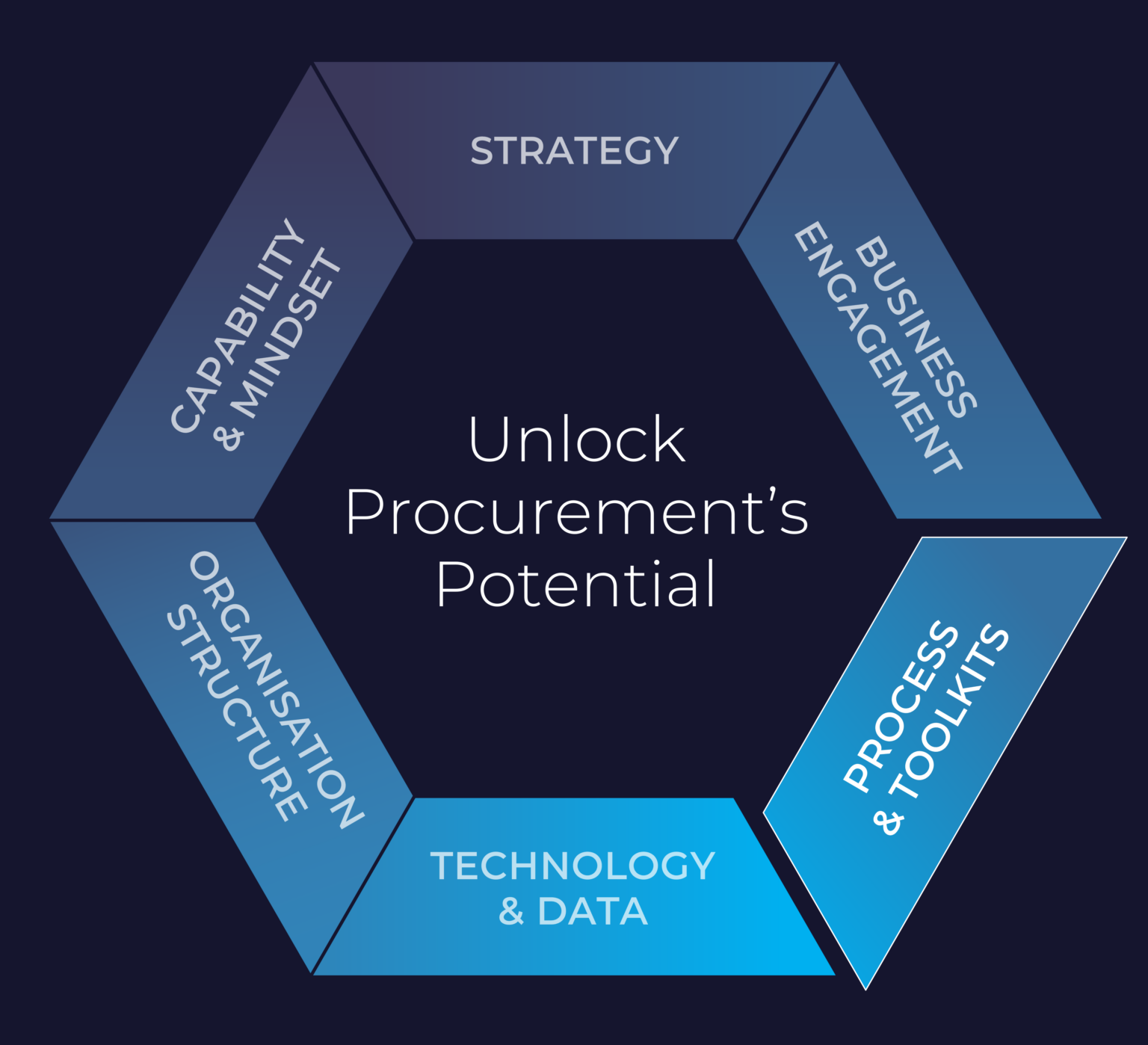
The Process dimension is built on three pillars:
- Capability Toolkits: Establishes integrated and high-quality tools for category, supplier, innovation, and risk management, ensuring they are accessible, consistently applied, and aligned with agreed quality standards. This provides the conceptual foundation – the business rationale, definitions (such as what Category Management means), and practical toolkits that enable effective execution.
- Process Documentation & Integration: Captures detailed process flows (often Levels 4 or 5 in a Business Process Management tool), process owners, the tools used, and the level of automation for each process. This includes integrating procurement processes with adjacent business processes such as S&OP, operational and design excellence, and ESG to drive cross-departmental alignment and clear process ownership that enable continuous improvement.
- Process Operationalisation & Improvement: Implements robust tracking, reviews, and reporting mechanisms to ensure compliance, performance, value delivery, and risk management. This establishes the structure for monitoring process execution, capturing insights, and driving continuous improvement through data and stakeholder feedback.
Why is it important?
Process provides the operational backbone that transforms procurement capabilities into consistent, measurable results. Without standardised, well-designed processes, even skilled teams with strong stakeholder relationships cannot deliver reliable outcomes or scale their impact effectively across the organisation.
Integrated tools and quality standards ensure that procurement activities consistently identify all available value opportunities, whether in category management, supplier relationships, or innovation initiatives. When procurement processes are designed, mapped, and integrated with broader business processes, procurement operates efficiently while maintaining the rigour needed for effective risk management and compliance, while also being ready to embrace automation, which can help increase efficiency and accuracy.
Most importantly, robust process frameworks enable continuous improvement and knowledge capture. Clear ownership, regular reviews, and stakeholder participation create accountability and learning loops that enhance performance over time or highlight opportunities for further simplification. This systematic approach distinguishes mature procurement functions that can deliver consistent value from those that rely solely on individual expertise – ensuring procurement’s contribution to business success is reliable, scalable, and sustainable.
How Process impacts other operating model dimensions
The Process dimension is strongly interconnected with every other operating model dimension, underscoring why getting this one right is so crucial. Your processes must directly support what procurement aims to achieve through its strategy – focusing on what is core and what drives the most value. Because an 8-step process is not aligned with the ambition to simplify.
Your organisational structure should reinforce this by assigning people to specific process areas, ensuring accountability and focus. Those people need to be trained and enabled to deliver processes effectively, while tools must support or automate execution. This creates a reinforcing cycle: well-defined processes guide capability development, which in turn drives better execution.
Importantly, processes must evolve as business requirements and technologies change. The Process dimension is not static – it adapts as your strategy shifts, your team’s capabilities grow, and new tools become available.
Why clarity and documentation define procurement maturity
Organisations often believe their processes are unique, yet few can show what truly differentiates them – mainly because their processes aren’t properly documented. This lack of clarity creates inefficiency and prevents organisations from learning best practices across industries.
Clearly defining business concepts and documenting process flows are hallmarks of leading procurement teams. It makes inefficiencies visible, highlights bottlenecks, and reveals where automation or redesign can create the most impact. Without this foundation, excellence remains out of reach.
Robust processes are the bedrock of procurement excellence. Clear process definitions reduce ambiguity, set expectations, and enable teams to execute consistently – regardless of individual expertise or experience levels. Standardisation doesn’t stifle creativity; it frees teams to focus on strategic value creation instead of reinventing the basics.
From definition to execution: Making processes work
Clarity in process design and documentation reduces ambiguity and enables efficient execution. Well-defined processes help people deliver effectively by setting clear expectations and standards, while also defining the requirements for the tools that support or automate them.
Process excellence requires continuous attention and improvement. As your procurement strategy evolves, your team develops, and new technologies emerge, your processes must adapt to remain relevant, efficient, and effective.
Of course, even the best-designed processes need the right tools to support them. Our next blog explores the Data & Technology dimension, where we’ll examine how digital tools, automation, and data analytics can amplify your procurement processes and unlock new levels of efficiency and insight.
Further reading in our procurement operating model series
- Why AI demands a procurement operating model rethink — and what it really means for your team
- Dimension 1: Strategy – Building your blueprint for success
- Dimension 2: Business Engagement – Elevating Procurement to a strategic partner
- Dimension 3: Process – Workflows that work
- Dimension 4: Data & Technology – Your Digital Advantage
- Dimension 5: Organisation Structure – Building teams that deliver
- Dimension 6: Capability & Mindset – Unleashing Team Potential
- Designing an AI-Native Procurement Operating Model > Download the white paper here
About Mark Webb
Managing Director
30+ years procurement experience in line management
and consulting roles.
Previous employment: Price Waterhouse, Mobil Oil and QP Group
Education: BSc in Management Science and MSc in Business by Research, Aston University
CIPS: Member
Further Reading

Blog
Dimension 2: Business Engagement – Elevating Procurement to a strategic partner
By Mark Webb |
Strong business engagement transforms Procurement from an isolated function focused on market engagement and supply side levers such as supplier selection and negotiation into an integrated business partner that also influences the demand side levers. Only by aligning, cohering and challenging requirements across the organisation are the full range of value opportunities accessed. Without genuine stakeholder buy-in and collaboration, Procurement teams operate with limited impact, confined to sourcing and incremental value delivery rather than driving breakthrough change and creating strategic value.
As the second dimension in our comprehensive Procurement Operating Model, Business Engagement focuses on building strong, collaborative relationships between procurement and internal stakeholders across the organisation.
When Procurement lacks clearly defined engagement principles and structures, teams struggle to demonstrate consistent value to stakeholders and suppliers. This keeps even capable Procurement functions trapped in reactive, compliance-focused roles instead of unlocking their potential for strategic impact.
This blog outlines the elements of the Business Engagement dimension and how they work together to transform procurement into a true strategic business partner.
What is the Business Engagement dimension?
Business Engagement focuses on building strong, collaborative relationships between Procurement and internal stakeholders across the organisation.
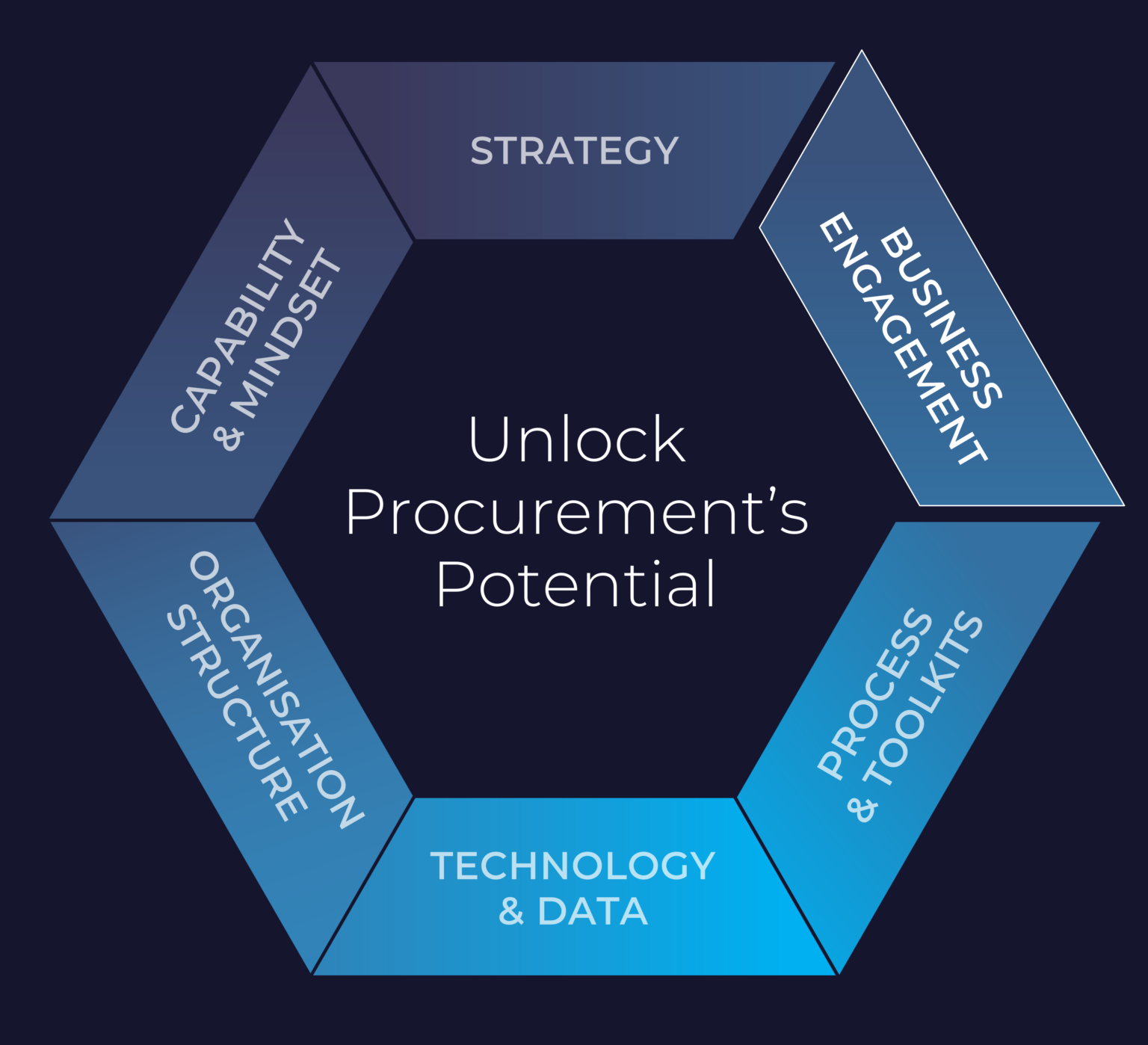
The Business Engagement dimension is built on four pillars:
- Senior Executive Support: Secures strong support for Procurement from executive stakeholders and establishes a clear mandate for Procurement to act on behalf of the business. This includes ensuring that key categories have formal and active sponsors from the business who champion procurement initiatives and provide the necessary authority to drive meaningful change.
- Communications & Engagement: Maintains formal stakeholder maps and communication plans to ensure business stakeholders have a comprehensive understanding of Procurement’s service offerings and initiatives. This enables category managers to have positive, proactive, and regular engagement with their category stakeholders, building trust and collaboration over time.
- Collaboration & Co-creation: Establishes formal processes for Procurement to engage with stakeholders to support budgeting, align strategies, and develop supportive programmes. This includes jointly prioritising the annual pipeline of procurement projects and co-creating category, supplier, and sourcing strategies with stakeholders.
- Operational Service Levels: Defines acceptable service levels, response times, and escalation paths agreed with stakeholders to support effective collaboration. This creates clear expectations and accountability frameworks that enable smooth day-to-day operations and professional working relationships..
Why is it important?
Executive support and formal sponsorship provide Procurement with the authority and resources needed to drive meaningful change. When business stakeholders understand Procurement’s value proposition and actively participate in strategy development, they become advocates, enabling procurement to influence critical value levers such as specification optimisation, demand management, and supplier integration.
Most importantly, effective business engagement creates sustainable partnerships where stakeholders are invested in procurement outcomes. Joint accountability for category and supplier targets and co-created strategies ensures that Procurement initiatives align with business priorities and receive the ongoing support necessary for successful implementation. This collaborative approach unlocks value that neither Procurement nor business stakeholders could achieve independently, making Procurement an essential contributor to organisational success.
How Business Engagement impacts your operating model
Procurement is not self-serving, and hence, business engagement is critical to everything the function does. The strategic direction established in Strategy (Dimension 1) will dictate how Procurement engages with the business and has direct implications for process design, organisational models, and the required skills to deliver effectively.
For example, some organisations implement formal business partnering roles that rely heavily on communication and influencing skills. These structural decisions flow directly from the engagement strategy and require specific capabilities to be successful.
Business alignment: The cornerstone of effective procurement
We believe business engagement is the most critical element of an impactful Procurement team. It is so essential to overall effectiveness that it warrants a dimension in its own right, rather than being included in other dimensions. As such, it has been a core part of our offering for over two decades.
Ready to build a strategic foundation for your procurement function? Contact us to discuss how we can help you develop a comprehensive operating model that drives real results.
Further reading in our procurement operating model series
- Why AI demands a procurement operating model rethink — and what it really means for your team
- Dimension 1: Strategy – Building your blueprint for success
- Dimension 2: Business Engagement – Elevating Procurement to a strategic partner
- Dimension 3: Process – Workflows that work
- Dimension 4: Data & Technology – Your Digital Advantage
- Dimension 5: Organisation Structure – Building teams that deliver
- Dimension 6: Capability & Mindset – Unleashing Team Potential
- Designing an AI-Native Procurement Operating Model > Download the white paper here
Let’s Talk
If you want to get more value out of your procurement spend, or you just want to know more about us, request a callback above or send us an email and we will come straight back to you.
Further Reading


Blog
Dimension 1: Strategy – Building your blueprint for success
By Mark Webb |
Picture a Procurement team that’s always putting out fires—scrambling to respond to urgent requests, chasing the lowest price, and struggling to demonstrate their value beyond transactional tasks. Now imagine the alternative: a Procurement function that anticipates business needs, drives innovation, manages risk proactively, and is recognised as a strategic partner by leadership.
The difference? Strategy.
As the first dimension in our comprehensive Procurement Operating Model, Strategy is the foundation upon which all other dimensions are built. Procurement strategy sets the direction for the function and enables alignment across people, processes, and technology. It defines how Procurement contributes to organisational success – not only through cost savings, but also through delivering a broader range of value, such as risk reduction, innovation, sustainability, and stakeholder satisfaction.
This blog outlines the elements of the Strategy dimension and how they need to be aligned to enable highly effective Procurement teams.
What is the Strategy dimension?
The Strategy dimension focuses on how Procurement supports the delivery of the overall organisation’s strategic objectives and defines the procurement policy that governs engagement between Procurement and the broader business.
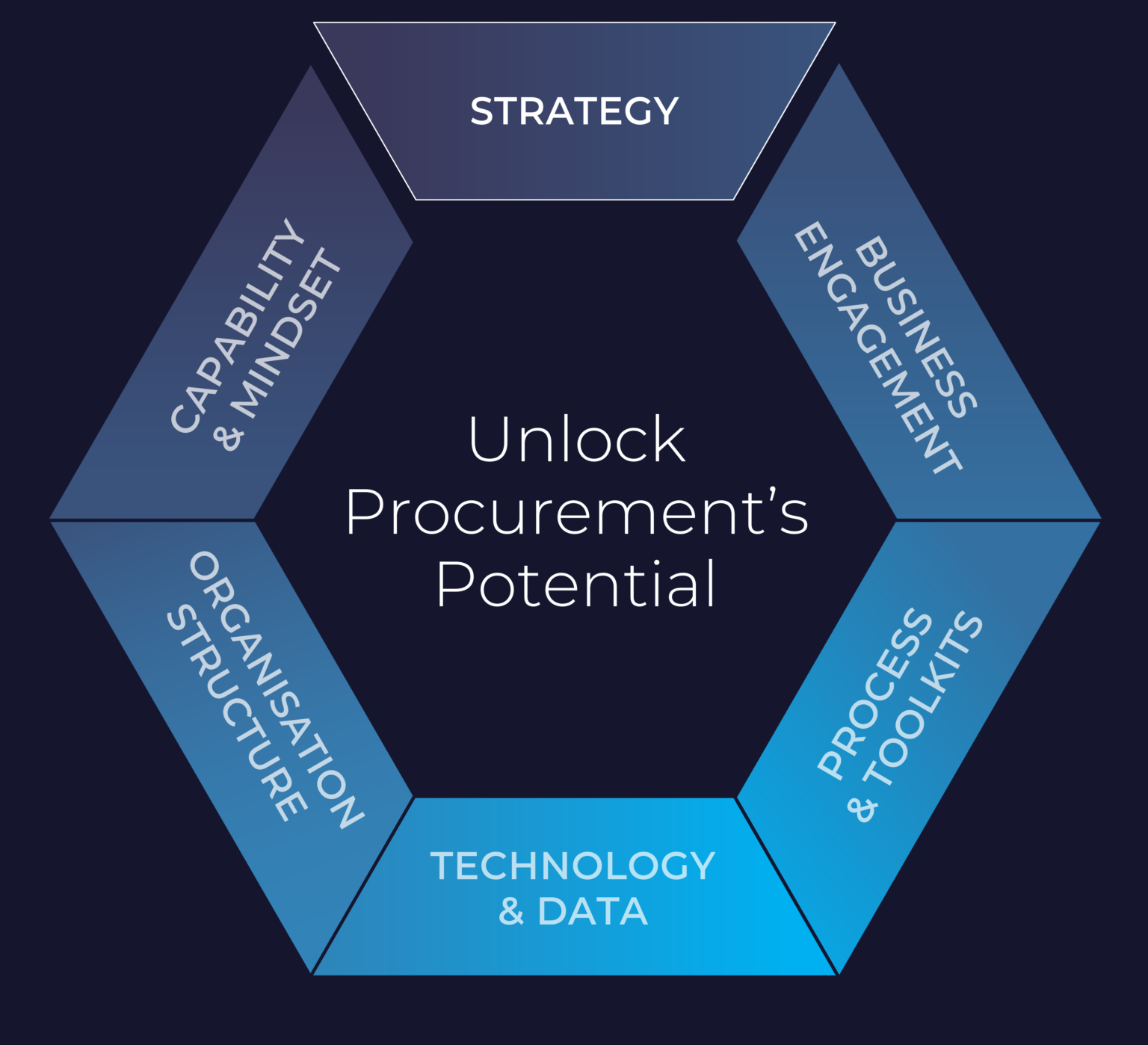
The Strategy dimension is built on four pillars:
- Vision & Ambition: To deliver true value, procurement needs a well-defined purpose, value proposition, and service scope. This requires a clear vision and strategy aligned with business objectives, as well as the KPIs against which procurement is measured.
- Governance: Articulates procurement rules and accountability through procurement policy and procedures. This includes establishing cross-functional steering groups and management reviews to make decisions and monitor delivery, which are further specified in the Business Engagement dimension.
- Procurement Planning: Procurement activities must be aligned with the organisation’s planning cycle. Procurement planning also includes outlining the financial investment required, ensuring sufficient resources are allocated to achieve the procurement vision and strategy.
- Performance Management: Procurement must demonstrate value delivery against defined objectives by structuring them into actionable initiatives with defined resources and timelines, and applying a comprehensive measurement process for both financial and non-financial KPIs. Through performance scorecards, regular reviews, and ongoing reporting, Procurement can track progress and continuously demonstrate alignment with business priorities.
Why is the Strategy dimension important?
Without a clearly defined strategy, Procurement remains reactive and transactional, rather than being a proactive, strategic partner. With a clearly defined strategy, Procurement gains the mandate, funding, and structure to drive measurable impact, supported by consistent reporting, transparent activity tracking, and performance scorecards that make progress visible.
Ultimately, a well-crafted procurement strategy provides a roadmap for how procurement evolves in tandem with the business, ensuring that resources, investment, and activities are aligned to deliver the broader business strategy and the immediate and long-term value required by the business.
Is your procurement strategy enabling the operating model you need?
Assess how effectively your procurement strategy is translated into action through governance, planning, performance management and organisational alignment.
How Strategy impacts your operating model dimensions
Strategy serves as the foundation that shapes every other aspect of your procurement operating model. Think of it as the blueprint that guides all other design decisions and governs its execution.
All other dimensions need to serve the purpose of the strategy and be designed with this direction in mind. For example, processes need to be created in line with your ambition, technologies selected to enable them, and resources and skills established to execute them. The key is not to over-engineer individual dimensions but to ensure they all contribute to your overarching vision.
Here’s a practical example: imagine your strategy focuses on enabling a self-serving organisation where stakeholders can act independently. A rigid approval and governance process – no matter how well-intentioned – would actually hinder this strategic objective by creating barriers rather than empowerment. This is where alignment within and across dimensions becomes critical.
Customer-centricity begins with strategic alignment
It’s essential to acknowledge that an organisational chart is not a strategy, and neither is digitalisation. Too often, organisations mistake structural changes or technology implementations for strategic thinking. But these are just tools—they don’t define what you’re trying to achieve or why.
Building a clear perspective on what Procurement wants to be known for and aligning it with what the business wants from Procurement is the real starting point of designing operating models. This is where customer-centricity truly begins, setting the guardrails, design principles, and success metrics for all other dimensions.
Taking action: Your strategic starting point
Defining a strategy is the starting point for designing processes, selecting tools, establishing teams, identifying the required skills, and defining the desired behaviours. It’s not just about determining how procurement wants to be seen, but also about aligning this with what the business wants Procurement to be.
We help organisations navigate this critical step by helping them surface their ambitions and building clear alignment with the broader business. Without this foundation, even the most sophisticated processes, advanced technologies, and skilled teams will struggle to deliver meaningful impact.
The journey toward strategic procurement begins with strategy; everything else builds upon it.
Ready to build a strategic foundation for your procurement function? Contact us to discuss how we can help you develop a comprehensive operating model that drives real results.
Further reading in our procurement operating model series
- Why AI demands a procurement operating model rethink — and what it really means for your team
- Dimension 1: Strategy – Building your blueprint for success
- Dimension 2: Business Engagement – Elevating Procurement to a strategic partner
- Dimension 3: Process – Workflows that work
- Dimension 4: Data & Technology – Your Digital Advantage
- Dimension 5: Organisation Structure – Building teams that deliver
- Dimension 6: Capability & Mindset – Unleashing Team Potential
- Designing an AI-Native Procurement Operating Model > Download the white paper here
About Mark Webb
Managing Director
30+ years procurement experience in line management
and consulting roles.
Previous employment: Price Waterhouse, Mobil Oil and QP Group
Education: BSc in Management Science and MSc in Business by Research, Aston University
CIPS: Member