The World’s largest benchmark for strategic excellence in Category Management
The Global Category Management Report is the world’s largest and most targeted benchmark data on the key success factors that deliver exceptional category management outcomes. It defines what good looks like, provides clarity on your situation, and delivers actionable recommendations on how to improve your category management processes.
Our approach
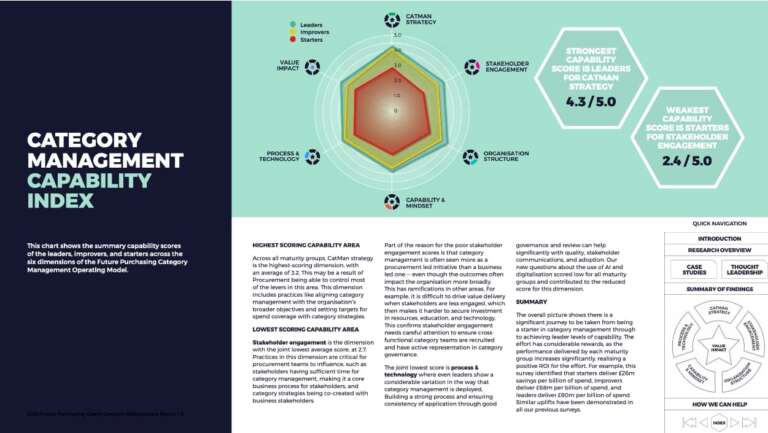
Over 12 years and six editions, we have continuously refined and aligned our approach with the requirements and desires of ambitious procurement organisations that want to drive tangible impact through strategic procurement. Together with Henley Business School and Mark Day, we have defined 90 capabilities that represent the process maturity of a procurement team across six operating model dimensions.
World-class benchmarking
For each operating model dimension, we provide detailed insights on every capability split by starters, improvers, and leaders. This way, you get bespoke insights on your current maturity and improvement opportunities. Combined with focused summaries and relevant case studies, the report is a holistic blueprint for what good looks like in category management.
Actionable recommendations
Explore how strategic category management can lead to substantial cost savings, risk reduction, and revenue enhancement. For every capability, the report contains a set of detailed recommendations for how to improve it and unlock untapped value. From process optimisation to tools and templates or digitalising the development and execution of category strategies – the Global Category Management Report is your Almanach for transforming your approach to category management.
“The size of this survey, and the rigour of the analysis applied by Professor Marc Day of Henley Business School, means that the results here have real objectivity and power. That is what makes this the most important piece of research we have ever seen conducted in this field”
– Peter Smith MD, Procurement Excellence Ltd & Co-founder of Spend Matters UK/Europe
Global Category Management Reports
2026: Procurement in the age of AI
Since the release of ChatGPT, the AI hype has only accelerated and swept over all parts of the businesses – and it didn’t leave Procurement untouched. From GenAI to AI agents, AI is bound to transform how procurement teams manage data, suppliers, and decisions. We have witnessed over 12 years of research that category management, the backbone of strategic procurement, is only fully adopted by 5% of organisations. In the last report, only 8% leveraged digital tools as part of their toolkit. The increased availability of digital tools and, especially, Artificial Intelligence might finally be the great equalizer and bridge the gap between leaders and starters – or it might widen it further. Procurement in the age of AI is full of promise, but has to overcome some persistent challenges around operating model structures, behavioural skills, and business engagement. This edition of the Global Category Management Report will highlight where to focus next.
Participate in the survey now and help us identify the challenges and opportunities of Procurement in the age of AI.
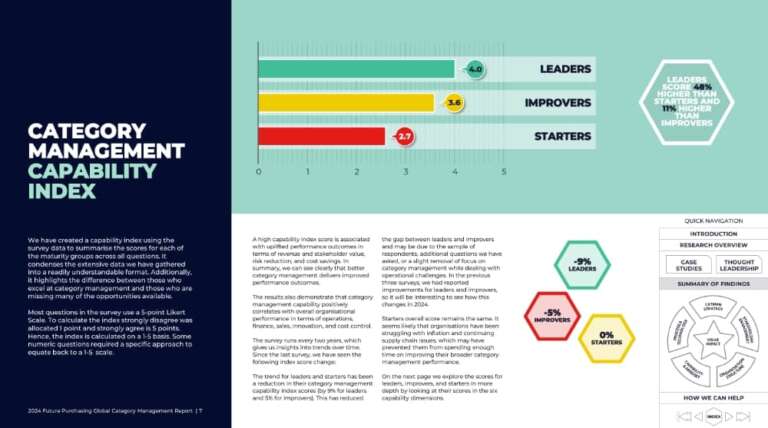
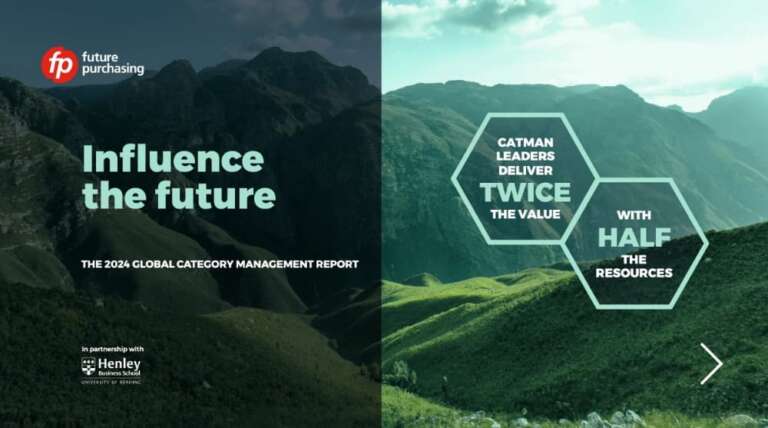
GenAI has transformed the world and keeps questioning which operational and strategic procurement capabilities will remain relevant once AI has found its place. Meanwhile, leaders in category management continue to capture more than 2x the value than less mature organisations in terms of risk reduction, cost savings, or operational efficiency, yet, report they only capture half of the total value available to them. Category management success requires a major operating model shift, not just implementing digital solutions or being stuck on strategic sourcing as the dominant activity and mindset. This edition of the Global Category Management Report is dedicated to influencing the future by providing a solid structure for designing the operating model and change programme required to maximise the benefits from (digital) category management and turn procurement into the strategic differentiator it desires to be.
2022: Fast tracking category management excellence
The 10th anniversary of the Global Category Management Report is the first after the Covid-19 pandemic. Procurement had to weather the perfect storm to keep supply chains and business operations functioning. Category strategies had to be built or re-built, and implemented at speed in order to meet the rapidly changing landscapes that organisations have been forced to cope with. Leading teams have used the opportunity to strengthen their approaches and move closer towards excellence, yet a large percentage of value remains unclaimed. Deeply integrating category management into the operating model is what fast tracks organisations on their path to excellence.
2018/2019: Mind the performance gap
For the first time digital tools are recognized as a probable way to remove transactional activity from their procurement teams and outsourcing low-value sourcing. RPA and even AI are already mentioned as ways to remove low-value tasks from procurement. At the same time, there is an increased recognition by procurement leadership teams that the success of category management is heavily dependent on business focus, change management, and behavioural skills of category managers. Our report therefore focused on the category management techniques that drive most value and included a list of Top 23 priority practices for closing the performance gap and a checklist to design and build their own programme.
2016/2017: Collaborating for category management success
Category Management has become the dominant procurement process and methodology to further procurement’s professional success and credibility for major businesses and public sector bodies in most geographies. But instead of being content with this development, leading organisations have identified that being close to the business and internal stakeholders is the key to successful category management programmes. Moving beyond procurement and honing the interpersonal skills required for effective collaboration is the new paradigm. And the report provides statistical evidence for the ROI of successful category management programmes.
2014/2015: Spotlight on procurement
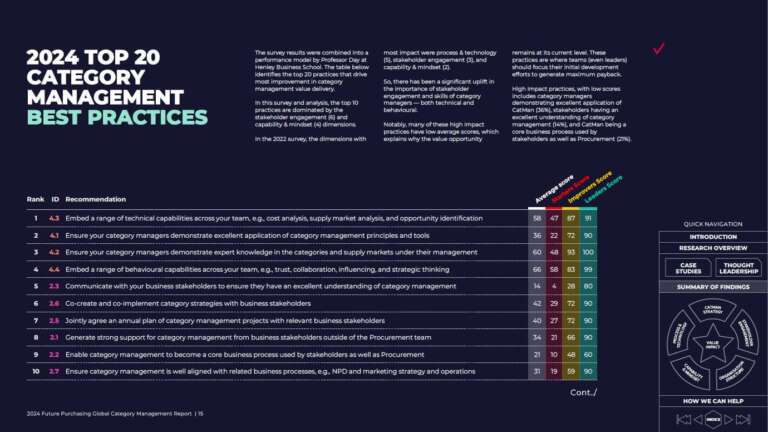
Procurement is well accepted as the core process for most Procurement teams, yet many perceive as relatively mundane, uninspiring and concerned with maintaining the status quo. This might be one reason why despite the proven value, many organisations are still unable or unwilling to fully embrace it. We believe category management is more aligned with John Kotter’s definition of leadership being about aligning people to a vision, gaining buy-in, creating motivation, and providing inspiration. It is about transforming the way a category is driven in the future. This second Global Category Management Report therefore puts a spotlight on procurement by introducing the category management performance index, sharing the best practices with most impact on organisation performance applied by category leaders.
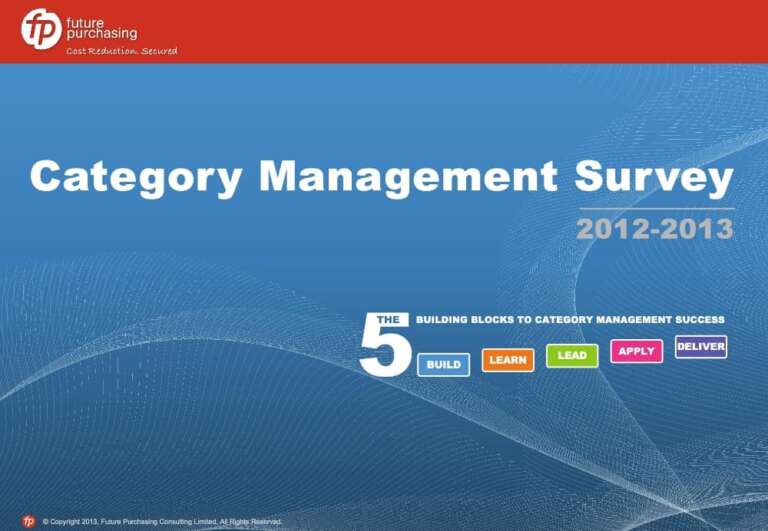
2012/2013: The 5 building blocks to category management success
Category management is the core process used by major Procurement teams to deliver value beyond traditional sourcing approaches. It is about building alignment with stakeholder requirements and creating long term strategies for managing spend. Despite its importance, limited research has been undertaken on the practicalities of implementing it successfully and identifying the factors that represent category management leadership. The Global Category Management Report is designed around Future Purchasing’s “Five building blocks of best practice Category management: Build, Learn, Lead, Apply and Deliver.” and aims to identify the specific building blocks and best practices that make the biggest difference to category management success, the extent to which they are used and the additional value secured through their use. It offers practical recommendations to help organisations execute each of the best practices identified and transform their category management capability.
Interested in unlocking your procurement performance?
Take the first step and assess the maturity of your category management approach with our unique benchmarking approach.