



Strategy & Design Guide
Procurement Operating Model
What is a Procurement Operating Model?
A Procurement Operating Model is the comprehensive framework that defines how an organisation structures, manages, and executes its procurement activities. It is a blueprint that covers everything from strategy to people, processes, technology, and governance. The purpose of a Procurement Operating Model is to drive alignment, efficiency, compliance, and value creation across the procurement function. It is the complete picture of how procurement operates, not just who reports to whom, but how work flows, how decisions get made, and how procurement connects with the rest of the business.
We have developed and refined our Procurement Target Operating Model over the past 20 years to capture the key aspects on which organisational and procurement success depends. The six interdependent dimensions of our Procurement Operating Model are: Strategy, Business Engagement, Processes & Toolkits, Data & Technology, Organisation Structure, and Capability & Mindset. While the six dimensions are rather stable, operating models are not static but need to adapt to changing business priorities, external realities, and technological advancements. AI is forcing a fundamental change to how organisations operate, reshaping how procurement creates value, makes decisions, and organises its people.
Adapting to this new reality requires designing the entire operating model around AI rather than bolting it onto individual capabilities. The result: the AI-native Procurement Operating Model.
Why is having a Procurement Operating Model important?
Strategic Procurement needs clarity of purpose: teams must understand not just what they are doing, but why and how it connects to the wider business. An operating model is like an engine, where each cog must engage with the ones around it, and a single misaligned part stops the whole thing from turning.
A well-designed operating model establishes clear processes, roles, and tasks as part of an integrated system with suitable governance frameworks. It provides clarity and enables procurement teams to make consistent, strategic decisions aligned with business objectives
while allowing the business to operate efficiently without disruption.
Ultimately, the operating model therefore enables Procurement to act as a strategic business partner and to drive measurable impact and business value. Without it, Procurement stays reactive and operational.
The 6-Dimensional Framework
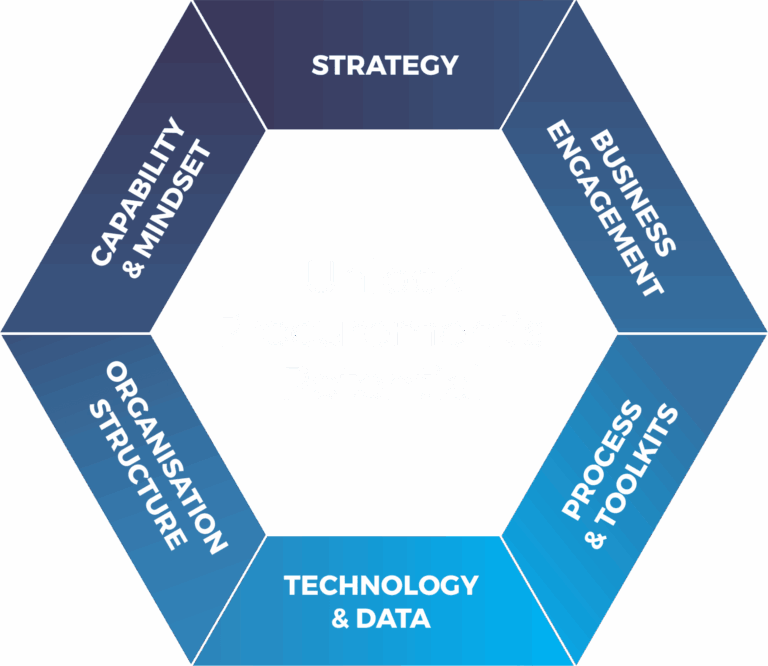
Exploring the 6 dimensions
DIMENSION 1
Strategy: Building your blueprint for success
The Strategy dimension focuses on how procurement supports the delivery of the organisation’s overall strategic objectives and defines the procurement policy that governs engagement between procurement and the broader business.
It sets the direction for the function and ensures delivery of both financial and non-financial value, such as cost savings, risk reduction, innovation, and stakeholder satisfaction. Built on a clear purpose, value proposition, and business-aligned vision, it structures objectives into actionable performance indicators and workstreams with change management, resources, and
timelines behind it.
Strategy is the foundation on which every other dimension is built. Processes are created in line with its ambition, technologies are selected to enable those processes, and skills are established to execute them.


DIMENSION 2
Business Engagement: Elevating procurement to a strategic partner
The Business Engagement dimension defines how procurement builds strong, collaborative relationships with stakeholders across the organisation.
It requires securing executive support, a clear mandate, and formal sponsorship for key categories, supported by stakeholder maps, communication plans, and agreed service levels.
Effective business engagement transforms procurement from an isolated function focused on market engagement and supply-side levers into a strategic partner that influences both demand and supply levers, unlocking greater value through co-created category, supplier, and sourcing strategies.
The direction set in Strategy dictates how procurement engages with the business, and that in turn shapes process design, organisational models, and the skills required to deliver.
DIMENSION 3
Processes & Toolkits: Workflows that work
The Processes & Toolkits dimension defines the capabilities, processes, strategic tools, and workflows that enable procurement to deliver high-quality outcomes efficiently and consistently.
It establishes toolkits and quality standards for core processes such as category, supplier, and risk management alongside sourcing and purchasing, and integrates them with adjacent business functions. It also implements robust tracking, reviews, and reporting mechanisms to ensure compliance, performance, value delivery, and continuous improvement.
Many functions define processes within each area but fail to consider how they connect or where handovers occur, leading to inefficiencies and gaps. This dimension is tied to every other one, because processes serve the strategy, tools automate their execution, and organisation structure and capabilities & mindset assign people and skills to them.

DIMENSION 4
Data & Technology: Your digital advantage
The Data & Technology dimension defines how procurement uses information assets, digital tools, and AI to improve operational efficiency, process accuracy, and value creation.
It establishes a clear data strategy that enables actionable insights and drives the digitalisation of core procurement processes. It oversees tools from category strategy development and strategic sourcing through to supplier and contract management and Purchase-to-Pay. It also owns the approach to identifying, testing, and scaling innovative technologies.
Technology exists to support processes by providing insight and automating execution. It also determines which tasks should be performed by humans and what skills they require. Processes, tools, and people are therefore highly interlinked when it comes to delivering the procurement strategy.
DIMENSION 5
Organisation Structure: Building teams that deliver
The Organisation Structure dimension defines how procurement is designed, resourced, and optimised to deliver its strategic objectives effectively and efficiently.
It establishes clear role definitions with reference capabilities, task descriptions, and responsibilities for categories, suppliers, and stakeholders, supported by effective reporting lines and agreed interfaces with other functions. It designs teams with sufficient capacity across activities, categories, spend levels, geographies, and business units, determining the appropriate organisational form, whether centralised, decentralised, or hybrid.
Organisation Structure must be built around the direction set in Strategy, the processes Procurement deems important, and the technology available to deliver it. Roles and size are derived from the desired processes and ways of working. Organisation structure therefore reflects the role Procurement wants to play and how it wants to show up.


DIMENSION 6
Capability & Mindset: Unleashing team potential
The Capability & Mindset dimension defines the roles, the competencies each role requires, and the learning & development pathways to achieve them, built around strong leadership and a shared mindset.
It provides unambiguous role descriptions, structured learning frameworks across technical, behavioural, and digital skills, clear career pathways, all held together by supportive leadership and reinforced by recruitment and retention strategies.
It is the dimension most closely connected to the others, since each depends on people equipped to operate it. Strategy sets the capabilities to develop, processes and tools require specific skills to run, and business engagement rests on the interpersonal strengths this dimension builds.
AI and emerging technologies
Procurement has absorbed three decades of technology, from ERP and P2P through to sourcing, spend analytics, and category management. Digitalisation has been a top priority for years, yet overall maturity and impact have not advanced much because technology was too often bought while ways of working remained unchanged. AI is the latest addition to Procurement’s toolkit.
Where legacy technology promised to improve the efficiency of existing processes, AI is destined to reshape organisational ways of working at a much more fundamental, structural level. AI reverses the long-standing trifecta of people, process, technology. Rather than starting from people and headcount, an AI-native model starts from strategy, then the processes and technology to deliver it, and only then the roles and capabilities needed to orchestrate and govern the whole.
Reducing transactional work while increasing strategic influence, improving governance and decision-making – these have profound implications across the Procurement Operating Model and on the role composition and team size of Procurement.
An AI-native Procurement Operating Model therefore means AI is the core organising principle, not an afterthought. It’s what separates teams that buy tools from teams that benefit from them. And it will separate the functions that lead this shift from those that spend the next decade catching up.

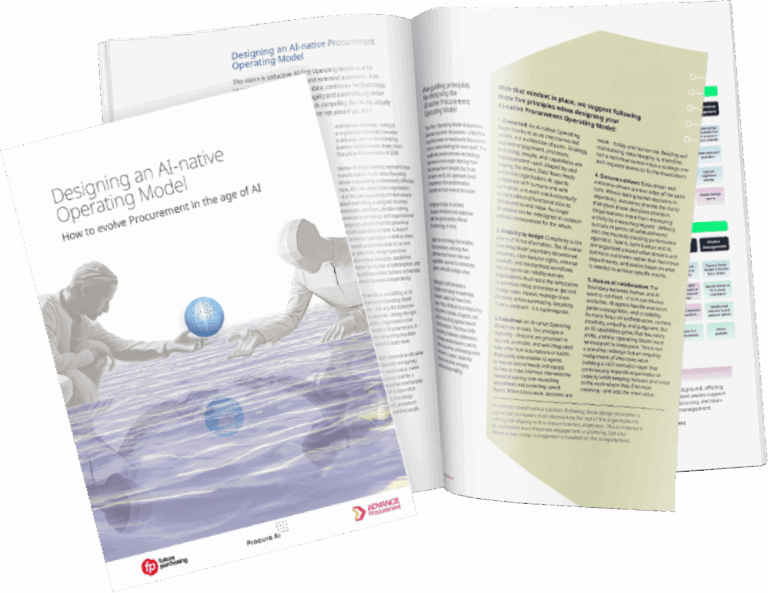
How to design the AI-native Procurement Operating Model
It explains how each of the six dimensions needs to evolve in the age of AI, the impact of agentic AI on procurement team size and role composition, and provides a practical framework for sequencing the transformation.
Establish your Procurement Maturity to define how to move forward
See how your function measures up against peers and the realities of AI. Our Category Management Maturity Assessment benchmarks you against 2,200 companies, then turns the results into a prioritised roadmap and shows you how much value is still on the table.