


Blog
Dimension 1: Strategy – Building your blueprint for success
By Mark Webb |
Picture a Procurement team that’s always putting out fires—scrambling to respond to urgent requests, chasing the lowest price, and struggling to demonstrate their value beyond transactional tasks. Now imagine the alternative: a Procurement function that anticipates business needs, drives innovation, manages risk proactively, and is recognised as a strategic partner by leadership.
The difference? Strategy.
As the first dimension in our comprehensive Procurement Operating Model, Strategy is the foundation upon which all other dimensions are built. Procurement strategy sets the direction for the function and enables alignment across people, processes, and technology. It defines how Procurement contributes to organisational success – not only through cost savings, but also through delivering a broader range of value, such as risk reduction, innovation, sustainability, and stakeholder satisfaction.
This blog outlines the elements of the Strategy dimension and how they need to be aligned to enable highly effective Procurement teams.
What is the Strategy dimension?
The Strategy dimension focuses on how Procurement supports the delivery of the overall organisation’s strategic objectives and defines the procurement policy that governs engagement between Procurement and the broader business.
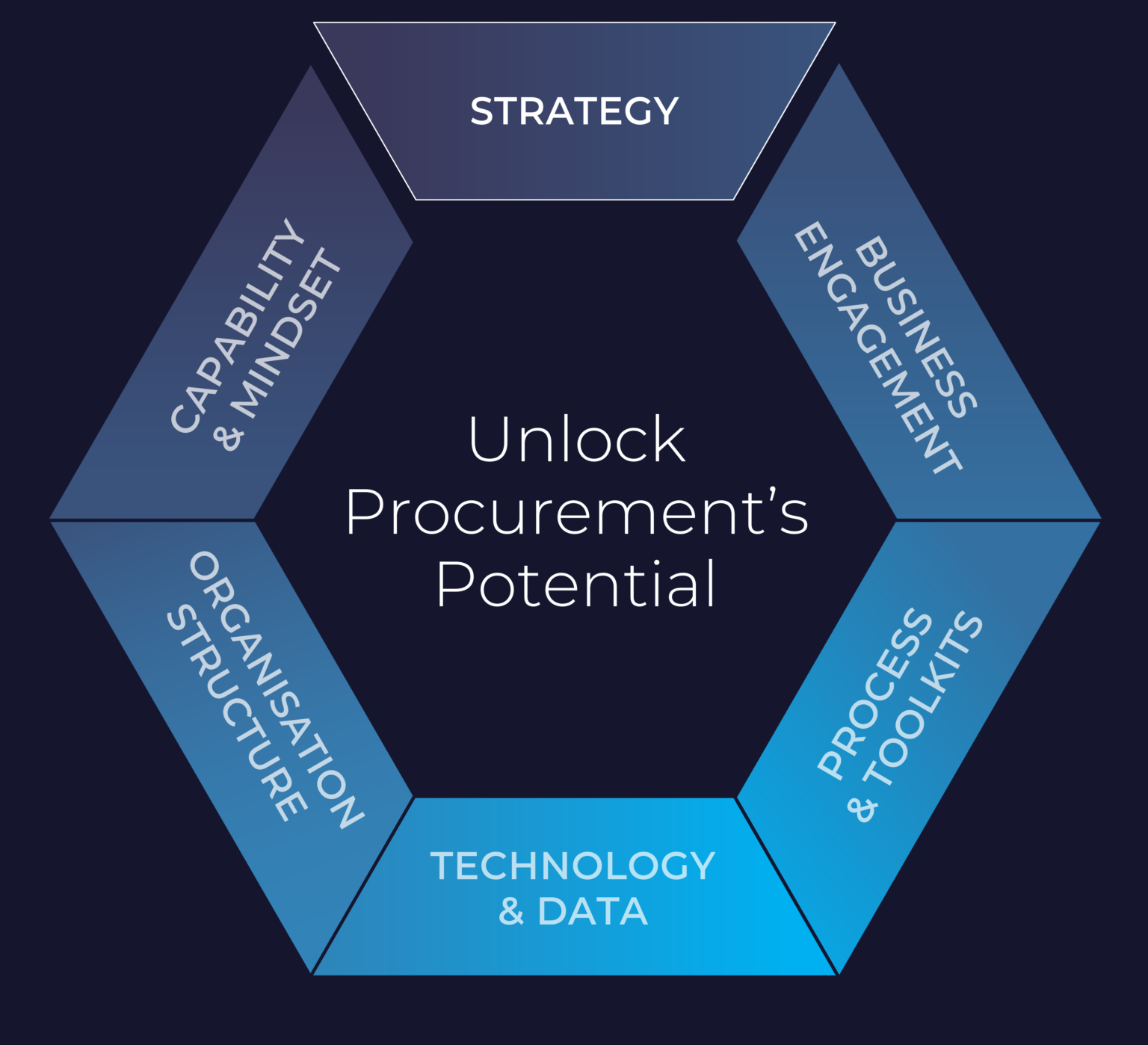
The Strategy dimension is built on four pillars:
- Vision & Ambition: To deliver true value, procurement needs a well-defined purpose, value proposition, and service scope. This requires a clear vision and strategy aligned with business objectives, as well as the KPIs against which procurement is measured.
- Governance: Articulates procurement rules and accountability through procurement policy and procedures. This includes establishing cross-functional steering groups and management reviews to make decisions and monitor delivery, which are further specified in the Business Engagement dimension.
- Procurement Planning: Procurement activities must be aligned with the organisation’s planning cycle. Procurement planning also includes outlining the financial investment required, ensuring sufficient resources are allocated to achieve the procurement vision and strategy.
- Performance Management: Procurement must demonstrate value delivery against defined objectives by structuring them into actionable initiatives with defined resources and timelines, and applying a comprehensive measurement process for both financial and non-financial KPIs. Through performance scorecards, regular reviews, and ongoing reporting, Procurement can track progress and continuously demonstrate alignment with business priorities.
Why is the Strategy dimension important?
Without a clearly defined strategy, Procurement remains reactive and transactional, rather than being a proactive, strategic partner. With a clearly defined strategy, Procurement gains the mandate, funding, and structure to drive measurable impact, supported by consistent reporting, transparent activity tracking, and performance scorecards that make progress visible.
Ultimately, a well-crafted procurement strategy provides a roadmap for how procurement evolves in tandem with the business, ensuring that resources, investment, and activities are aligned to deliver the broader business strategy and the immediate and long-term value required by the business.
Is your procurement strategy enabling the operating model you need?
Assess how effectively your procurement strategy is translated into action through governance, planning, performance management and organisational alignment.
How Strategy impacts your operating model dimensions
Strategy serves as the foundation that shapes every other aspect of your procurement operating model. Think of it as the blueprint that guides all other design decisions and governs its execution.
All other dimensions need to serve the purpose of the strategy and be designed with this direction in mind. For example, processes need to be created in line with your ambition, technologies selected to enable them, and resources and skills established to execute them. The key is not to over-engineer individual dimensions but to ensure they all contribute to your overarching vision.
Here’s a practical example: imagine your strategy focuses on enabling a self-serving organisation where stakeholders can act independently. A rigid approval and governance process – no matter how well-intentioned – would actually hinder this strategic objective by creating barriers rather than empowerment. This is where alignment within and across dimensions becomes critical.
Customer-centricity begins with strategic alignment
It’s essential to acknowledge that an organisational chart is not a strategy, and neither is digitalisation. Too often, organisations mistake structural changes or technology implementations for strategic thinking. But these are just tools—they don’t define what you’re trying to achieve or why.
Building a clear perspective on what Procurement wants to be known for and aligning it with what the business wants from Procurement is the real starting point of designing operating models. This is where customer-centricity truly begins, setting the guardrails, design principles, and success metrics for all other dimensions.
Taking action: Your strategic starting point
Defining a strategy is the starting point for designing processes, selecting tools, establishing teams, identifying the required skills, and defining the desired behaviours. It’s not just about determining how procurement wants to be seen, but also about aligning this with what the business wants Procurement to be.
We help organisations navigate this critical step by helping them surface their ambitions and building clear alignment with the broader business. Without this foundation, even the most sophisticated processes, advanced technologies, and skilled teams will struggle to deliver meaningful impact.
The journey toward strategic procurement begins with strategy; everything else builds upon it.
Ready to build a strategic foundation for your procurement function? Contact us to discuss how we can help you develop a comprehensive operating model that drives real results.
Further reading in our procurement operating model series
- Why AI demands a procurement operating model rethink — and what it really means for your team
- Dimension 1: Strategy – Building your blueprint for success
- Dimension 2: Business Engagement – Elevating Procurement to a strategic partner
- Dimension 3: Process – Workflows that work
- Dimension 4: Data & Technology – Your Digital Advantage
- Dimension 5: Organisation Structure – Building teams that deliver
- Dimension 6: Capability & Mindset – Unleashing Team Potential
- Designing an AI-Native Procurement Operating Model > Download the white paper here

About Mark Webb
Managing Director
30+ years procurement experience in line management
and consulting roles.
Previous employment: Price Waterhouse, Mobil Oil and QP Group
Education: BSc in Management Science and MSc in Business by Research, Aston University
CIPS: Member