


Blog
From skills to capability: Designing a Procurement Academy that delivers real performance
By Mark Hubbard |
Procurement capability has never been static, but the pace of change over the last few years has been exceptional. Regulatory pressure, supply-chain disruption, ESG requirements, rapid advances in digital tools, and the emergence of AI have fundamentally altered what is expected of modern procurement professionals.
At the same time, the traditional foundations of the profession have not disappeared. Category management, sourcing, negotiation, supplier management, risk, contracting, financial acumen, and process discipline remain central to success.
The challenge is not replacement, but expansion. Today’s category managers are expected to combine deep functional expertise with strong behavioural skills and increasing levels of digital and analytical fluency—yet technical skills alone are rarely what limit performance. In practice, the biggest constraints tend to be behavioural: influencing without authority, navigating conflict, managing change, telling a compelling commercial story, and adapting thinking when established approaches no longer work.
These so-called “soft skills” (Overview of Top 10 key skills for the age of AI) have always mattered, but as procurement becomes more cross-functional and technology-enabled, they have become mission-critical. With tight headcounts and a competitive talent market, organisations cannot simply hire their way to capability. The focus has shifted decisively toward reskilling and upskilling existing teams. This creates a simple but uncomfortable truth for organisations: traditional training approaches are no longer sufficient.
This article explores how skills frameworks, targeted assessment, practical learning design, management reinforcement, and robust evaluation can be combined to form an effective Procurement Academy where learning is treated as a system rather than an event.
Building the foundation: Skills frameworks and assessments
What is a skills framework and why do you need one?
One of the most common mistakes in procurement learning is jumping straight to courses. A far more effective starting point is a clear skills framework: a shared, structured view of the capabilities required in different procurement roles, with explicit descriptions of what good looks like at each level.
Procurement teams are rarely homogeneous. Backgrounds, experience, and strengths vary widely. A well‑designed skills framework creates a common language, aligns expectations, and enables individuals and organisations to identify genuine development priorities rather than relying on intuition or anecdote.
Critically, effective frameworks balance three dimensions:
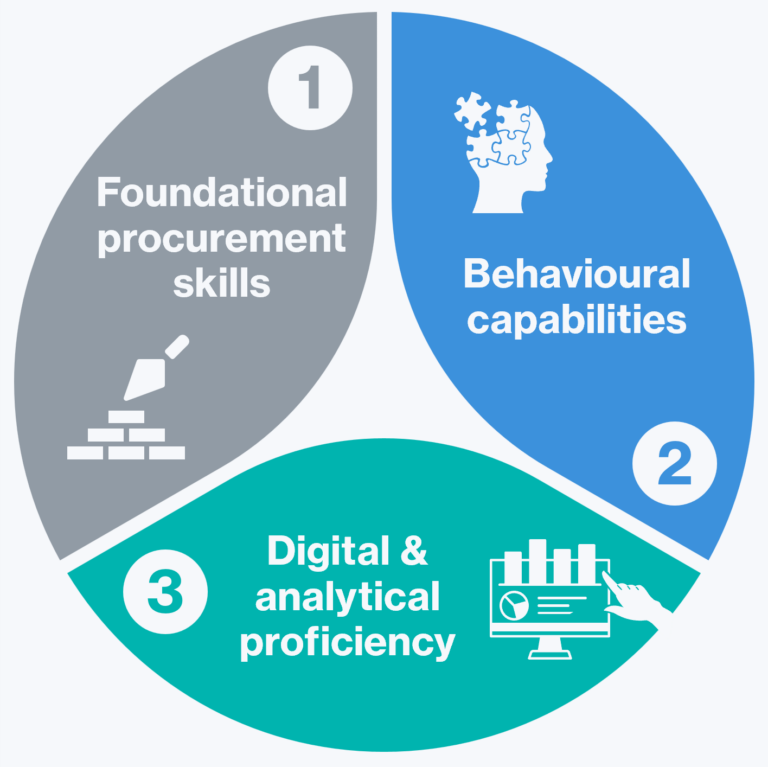
- Foundational procurement skills
- Behavioural capabilities
- Digital and analytical proficiency
Over‑emphasising any one of these at the expense of the others almost always leads to sub‑optimal results.
Using skills assessments to target development
Once you’ve built your skills framework, assessments measure where your team stands against it. They reveal individual and team strengths, surface hidden talent, and expose the capability gaps that genuinely matter to your organisational strategy.
No single assessment method is perfect. Self‑assessments, manager input, moderated reviews, and 360‑degree feedback all have strengths and limitations. The real value comes from consistency, calibration, and repetition over time. When assessments are repeated periodically, organisations can track progress, measure the impact of development activity, and adjust learning plans as needs evolve.
Importantly, assessments only create value if they lead somewhere. Individuals must be able to see how assessment outcomes link to development opportunities, role expectations, and career progression. Without this connection, even well‑designed assessments quickly lose credibility.
Designing and delivering effective learning
From knowledge transfer to performance change
Even with clear capability definitions, learning fails if it focuses solely on knowledge transfer. Understanding theory is necessary, but it is not sufficient. Real value is created when participants apply what they have learned in their own environment and deliver improved outcomes.
This has direct implications for learning design. Programmes must be built around explicit performance outcomes, not simply content coverage. They also need to reflect real-world constraints, particularly time. Compressing complex topics into short workshops inevitably forces trade-offs between breadth and depth, making thoughtful design essential.
Effective training programmes typically combine focused theoretical input with demonstrations, discussion of practical challenges, and structured opportunities to apply learning to participants’ own contexts. In fast-moving areas such as AI and digital procurement tools, content must also remain adaptable, allowing learning to evolve as the landscape changes.
Treating learning as a system, not an event
Learning should not be treated as a one-off event but an ongoing journey. This principle is often captured in the 70:20:10 model, describing how individuals learn. While the precise ratios can be debated, the core insight remains: most learning happens through application, supported by social interaction, with formal training acting as an enabler rather than the centre of gravity.
This makes post-programme reinforcement critical. Formal learning must be explicitly linked to what participants are expected to do differently once they return to their roles. Equally, line managers need clarity on how they are expected to support, observe, and reinforce that change.
This is also where many programmes fail. Line managers are often expected to act as coaches without alignment with the training objectives or access to the tools to support them. Effective professional coaching follows its own rules, and where possible, learning programmes need to anticipate this risk and put appropriate structures, guidance, and support in place.
Measuring what matters
If the purpose of learning is performance improvement, measurement of training effectiveness must extend well beyond immediate feedback. The Kirkpatrick model remains valuable precisely because it forces this broader perspective—moving from participant reaction and knowledge gain through to behavioural change and measurable business results.
Most training evaluation stops at “Did people like it?” and “Did they learn something?” The harder questions are: “Are they doing anything differently?” and “Has performance improved?” These are the questions that matter.
Procurement measurement is often too narrowly focused on cost reduction alone. While important, this rarely captures the full value of improved category strategies, risk management, or stakeholder alignment. Effective evaluation links learning objectives, role expectations, and business outcomes in a coherent and transparent way.
Bringing it all together: The Procurement Academy approach
When skills frameworks, assessment, outcome‑led design, structured application, management reinforcement, and meaningful evaluation are brought together, training stops being a series of disconnected courses. Instead, it becomes a learning system.
This is the essence of a Procurement Academy. It provides a structured capability journey aligned to organisational strategy, role expectations, and real performance improvement. It evolves as skills requirements change and supports continuous learning rather than one‑off interventions.
For organisations that want procurement to deliver greater strategic value, measurable outcomes, and genuine change in an increasingly complex environment, learning needs to be thoughtfully designed from the start.
Building your Procurement Academy
At Future Purchasing, we help organisations design and deliver Procurement Academies that drive measurable performance improvement. From developing tailored skills frameworks and conducting capability assessments using our Compass Competency Framework tool, to designing outcome-focused training programmes and evaluation frameworks, we support the complete capability development journey.
Whether you’re looking to structure your first formal learning programme or transform existing training into a strategic capability system, we can help you deliver real results from your Procurement Academy.
Get in touch to discuss how a Procurement Academy could work for your organisation.

About Mark Hubbard
Director
30+ years experience in procurement and supplier management, in line and consulting roles
Previous employment: Positive Purchasing Ltd, SITA,
QP Group, BMW, SWWS, Rover
Education: BSc in Engineering Metallurgy, MBA University of Plymouth
CIPS: Member