


Blog
Strategic Alignment in Procurement: From Strategy to Business Value
By Mark Hubbard |
Strategic business alignment turns strategy into shared priorities
Many procurement teams have a (category) strategy they are proud of. Few can point to a decision it actually changed.
That gap is a real problem we see quite often. The function has a clear ambition, a tidy set of objectives and a well-rehearsed value proposition. Category teams spot genuinely good opportunities, and stakeholders turn up to the planning sessions. Yet month after month, resources get consumed by urgent requests and whoever happens to shout loudest. The missing link is strategic business alignment.
‘Strategy’ and ‘Business Engagement’ are the first two dimensions of the Procurement Operating Model, and strategic alignment is the piece that connects them. Strategy defines direction while Business Engagement enables collaboration. Strategic alignment converts both into shared decisions and an executable portfolio of work.
Strategic business alignment is the process through which Procurement and the business translate strategy into shared priorities, agreed trade-offs, and an executable portfolio of work.
Get the connection right and Procurement and the business agree where to focus, what they will achieve together, and how limited resources will be spent. Get it wrong, and even the best strategy stays on the shelf, while stakeholder engagement becomes a run of pleasant but inconsequential conversations.
Strategy sets the direction, but it does not make the choices
Strategy is the first dimension of an effective Procurement Operating Model. It sets the direction, defines Procurement’s purpose, ambition, and value proposition. It agrees on how performance will be measured, and explains how the function will contribute to the wider organisation. That contribution should reach well beyond price savings, into resilience, growth, risk, sustainability, innovation and simply making the business easier to buy for.
What strategy does not do is tell you which categories, suppliers or initiatives to tackle first. Say your strategy makes resilience a priority. You still have to work out which supply markets carry the most exposure, where you can realistically intervene, and what to do first. Say it commits Procurement to supporting growth. You still have to find the business plans that depend on new suppliers, extra capacity, or faster sourcing. Say it leans harder into sustainability. You still have to pin down where the impact is concentrated and which interventions are actually achievable.
Strategy alone can’t make those choices, and Procurement cannot make them on its own. They call for close collaboration with the business, and that starts with engagement.
Engagement matters, but it is not the finish line
Business engagement is one of the most important aspects of Procurement. We need strong relationships, regular conversation, and a real understanding of what stakeholders are trying to achieve. Category and business teams cannot build anything relevant without them.
The purpose of business engagement is better joint decisions: Procurement and the business agreeing on what matters, what they will do, who will own it, and how success will be measured.
The trouble is that engagement often becomes the objective itself. We count the meetings, draw the stakeholder maps, and chase general buy-in for our plans. All of that can improve relationships, but having good relationships is not the same as alignment. Getting there takes more than goodwill and good relationships – it needs formal structure.
The Business Engagement dimension of the operating model provides this structure for effective stakeholder engagement. Senior sponsorship gives Procurement the mandate to challenge requirements and coordinate across functions. Communication builds a shared understanding of Procurement’s purpose. Collaboration and co-creation let both sides shape plans and priorities together. Clear service levels keep the day job from swallowing the strategic work whole.
This combination creates engagement built to last rather than being a one-off exercise filed away. It forms a living relationship with forums where shared decisions can be made and revisited.
None of this is as simple as asking stakeholders what they want. They see priorities through the lens of their own function, while Procurement brings an enterprise view of spend, supply markets, risk and cross-functional demand.
Real alignment asks both sides to challenge each other’s assumptions and make trade-offs, and that is the point where Procurement stops taking orders and starts acting as a business partner.
Strategic alignment: from intent to outcomes
With direction set by strategy and the machinery of engagement in place, strategic alignment is where the two turn into action. It is the structured process through which Procurement and the business convert strategic intent into an agreed portfolio of work, weighing the organisation’s priorities, category and supplier opportunities, market and risk developments, and the resources both sides can actually commit.
Most organisations have far more procurement opportunities than they can ever pursue. Nearly every major category holds savings potential, suppliers with development or de-risking needs, business users with urgent or strategic initiatives, and advancing regulatory, technology, or sustainability requirements.
In practice, it requires the most senior category group leaders to work with their relevant stakeholders eg R&D, Marketing, Operations etc. To review these opportunities on an aggregated level.
Trying to tackle everything at once leads to dilution: overloaded category managers, patchy stakeholder support, and strategies written but never implemented. The real work of strategic alignment is not to lengthen the list of opportunities but to channel multiple simultaneous conversations into broader category group strategies – typically 6-10. Strategic alignment is about choosing what to focus on and where to focus scarce capacity.
In practice, alignment runs as a chain, with each link depending on the one before it.
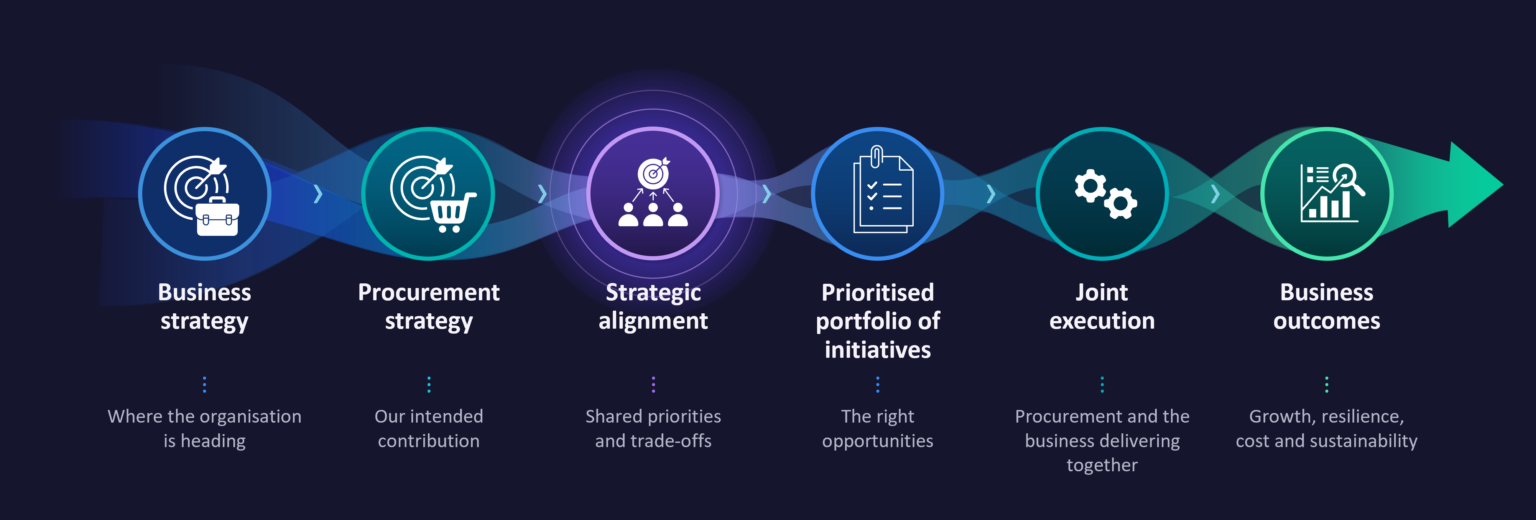
It begins with business strategy. Before Procurement commits to anything, it needs to understand where the organisation is heading: what it is trying to achieve, where it is investing, which capabilities are set to grow, where cost pressure is building, and what it has promised customers, regulators and investors. This is why we start with business priorities rather than the spend cube.
A large category is not automatically a strategic one, and a smaller one may prove critical to growth, continuity, or compliance. Clean category definitions help here, because a taxonomy built around real supply markets rather than budget lines is what lets important opportunities surface. That understanding shapes the procurement strategy: Procurement’s own priorities and intended contribution, set in response to the business rather than in isolation.
Alignment is the point where that direction meets the business itself. Through the engagement just described, Procurement and the business test each other’s assumptions, weigh competing demands, and agree where the effort should go (on category manager and senior leadership level). The result is shared priorities and explicit trade-offs: naming what will be done, and being just as clear about what will wait.
Those priorities become a portfolio of initiatives, whether category strategies, sourcing projects, supplier development, or risk and demand work. Each carries an owner, a business sponsor, the resources it needs, and a measure of success, and the sequencing is visible, so a smaller initiative with a willing sponsor and a clear run can rightly go ahead of a larger one that lacks data or market readiness. The aim is not the biggest number on paper, but the strongest portfolio the organisation can actually deliver.
The portfolio is then executed jointly, with Procurement and the business delivering together rather than Procurement working to a plan the business has forgotten it agreed to. And because conditions change, it is reviewed regularly rather than set once a year. Priorities shift, risks materialize, and new options appear, so continuous alignment means checking often that the portfolio still reflects the strategy and is executed as planned.
Done well, the chain ends where it should, in business outcomes: not sourcing events or savings counted for their own sake, but the growth, resilience, cost and sustainability results the organisation set out to achieve.
This is what makes strategic business alignment the connective tissue of the operating model across all layers of the organisation and seniority. Strategy, Business Engagement, and the other dimensions only create value when alignment points them at the outcomes the business is trying to reach. Get it right, and it stops being something Procurement delivers for the business, and becomes what Procurement and the business achieve together.
Turn procurement strategic business alignment into measurable action
A strategy only creates value when it shapes the decisions you make. We help procurement teams connect business priorities, category opportunities, and available resources to build a focused, deliverable portfolio of opportunities. And to build an operating model that keeps them aligned as conditions change.
Talk to us about strengthening your procurement strategic business alignment

About Mark Hubbard
Director
30+ years experience in procurement and supplier management, in line and consulting roles
Previous employment: Positive Purchasing Ltd, SITA,
QP Group, BMW, SWWS, Rover
Education: BSc in Engineering Metallurgy, MBA University of Plymouth
CIPS: Member