


Blog
Why change management is the key to procurement technology adoption
By Mark Hubbard |
Procurement has never had more technology at its disposal than today. Thirty years of ERP, purchase-to-pay, sourcing platforms and spend analytics have reshaped the digital landscape. Yet the uncomfortable truth is that around 80% of digital transformation initiatives have historically failed to deliver the promised value. AI now promises another step change in efficiency and value, but unless procurement can break the cycle, the promise of AI will go the same way, and the strategic impact that CPOs seek will remain frustratingly out of reach.
The technology matters: it must be usable, connected and designed around the work people need to perform. But even good technology will underdeliver if the organisation does not change the processes, roles, capabilities and behaviours around it. What fails is adoption. Buying the tool is the easy part. The hard part is getting people to adopt genuinely new ways of working. Adoption is directly correlated with the targeted performance outcomes from the technology and the ROI from the investment.
This article outlines the patterns behind the failures, explains why AI raises the stakes, and shows how to build a deliberate plan for change and enablement to stop the pattern repeating.
Three patterns behind failed technology projects
Gartner notes that change management and training requirements are frequently underestimated, and that effective adoption requires teaching the tools and adapting the processes they support. Without aligned capabilities and ways of working, operational and implementation risks rise.
Decades of procurement digitalisation reveal three recurring patterns behind projects that fail to deliver, and AI is now intensifying all three.
1. The operating model never changes
New technology is often bolted onto existing processes, procedures, and ways of working, and then expected to deliver on its own. For a tool to deliver, the work and the processes around it have to be built in a way that amplifies it.
As we describe in our operating model blog series and the accompanying whitepaper, a procurement operating model is shaped by several interlocking dimensions, and adding a new tool has implications across all of them. Those implications need to be addressed deliberately, not assumed away.
When those implications are ignored, the outcome is a familiar one: technology invested in, ways of working unchanged, results that underwhelm.
2. Cutting change management and enablement investment
For reasons that are not always clear, training, communication, and capability-building are often the first things to come under scrutiny. In almost every technology implementation and consulting project, discussions about trimming enablement spend are expected.
It also shows the difficult relationship between technology providers and consultants, as technology providers try to make the sale and don’t want deals to stall because of implementation fees.
This is a mistake, and a costly one. In our experience, the correlation is unmistakable: the investment a business makes in training and enablement is directly reflected in the level of adoption its tools achieve. Enablement is precisely what converts a license into a working capability. Cut it, and adoption never builds.
Think about it this way: If a tool costs you £/EUR/$200,000/year, how much are you willing to spend to ensure the teams actually use it? I would recommend you have another look at the business case to see how much of the promised value hinges on actual adoption.
3. Teaching the tool, not the capability
The third pattern is subtler and hides within organisations that believe they are doing enablement properly. Most implementations train people how to use the tool. Even when this is badged as enablement, it usually stops at the interface level: which buttons to press, which fields to complete, which report to run. What it skips is the underlying capability and business context.
When training covers the tool but not the capability beneath it, people can navigate the software and still cannot do the work well. But teaching someone to operate a tool is not the same as building the judgement to know whether its output is any good. When this happens, adoption stalls for reasons that look mysterious but are entirely predictable.
We have seen many solution providers claim to help you avoid training as their tool guides the users through the process. Buy the ticket, get on the ride. Without building the capability, you degrade the users to passive bystanders, not capable drivers.
These three patterns all share a root cause: organisations treat implementation as a technology project rather than a business transformation encompassing people and processes.
How AI intensifies the three technology adoption failure patterns
The warning signs are already in the data. Gartner reports that only around 18% of procurement functions are currently seeing a return on their AI investments, and fewer than a third of sourcing and procurement employees agree that AI has a positive impact on their work. (Source: Gartner, 3 Change Management Actions to Improve Procurement AI Adoption, April 2026)
More concerning still, Gartner projects that by 2028, roughly 30% of AI projects will fail through silent subversion, where employees do not object openly but quietly carry on as they always have.
Increased pressure on change management in the age of AI
While the content and principles of change management hold true for AI implementations, Gartner explains that AI change management is more complex than traditional technology implementations for four key reasons:
- Nature of impact: AI is not just an IT concern and does not land on everyone equally, so a single uniform rollout will not work.
- Speed of change: Rapid developments, such as LLM integration, can quickly create change fatigue.
- Level of uncertainty: People want to know how their role and daily tasks will change, and what new skills they will need.
- Connection to work friction: Automating a routine task only works if the underlying process friction is solved first. Otherwise, automation is not feasible.
How these pressures sharpen technology adoption failure patterns
The work-friction pressure makes pattern one worse (no changes to the operating model). Gartner finds that AI often adds friction rather than removing it, with only about 27% of procurement staff strongly agreeing that AI improves their efficiency. Automating a broken process does not fix the mess; it accelerates it and generates a heavy workload of exception management as cases that the automation cannot handle pile up.
The uncertainty and fatigue pressures make pattern two worse (cutting change management investment). These are exactly the conditions in which enablement matters most, and exactly the conditions in which organisations are most tempted to cut it. Skipped enablement here turns directly into silent subversion.
AI sharpens pattern three most of all (teaching tools, not capabilities). The gap between operating a tool and having the judgement to check its work was always a problem, but AI widens it dramatically. A traditional system does more or less what it is told, so the cost of shallow capability is a misfiled purchase order or a clumsy report. An AI tool produces confident, plausible output that can be subtly wrong, and someone who has only been taught to operate it has no way to tell. Without the underlying capability to know what good looks like, people either wave the output through or stop trusting the tool altogether. Both routes end in failed adoption.
A clear plan for change and enablement in the age of AI
The pattern only continues if you let it. A deliberate plan for implementing AI and running change and enablement initiatives is what breaks it. The steps below set out what that plan looks like in practice.
Build a roadmap that sequences enablement, not just technology
A roadmap should begin with the problem you are solving, not the tool. Build a portfolio of use cases, prioritise them by impact and ease of implementation, and sequence quick wins first to build momentum.
Enablement starts before technology and runs through delivery
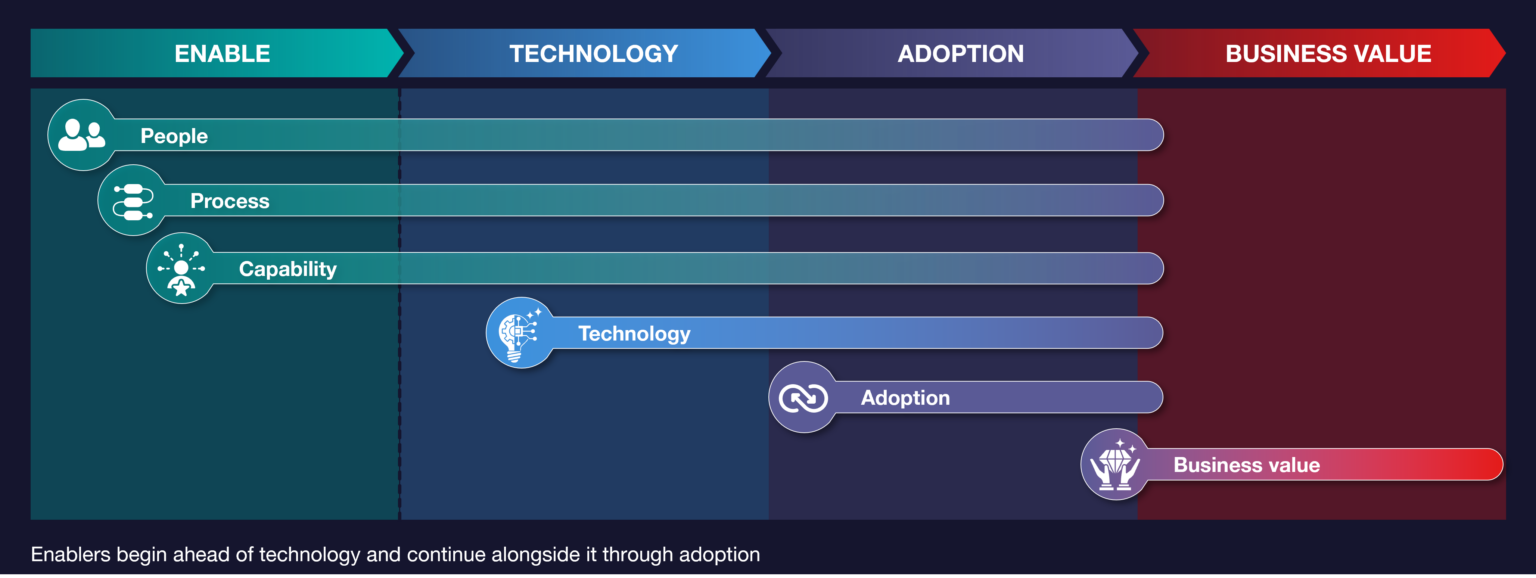
The roadmap is an enablement sequence as much as a technology one, which is what keeps people enablement running through every stage rather than tacked on at the end.
Extend your skills framework to include digital and AI capabilities
A skills framework is the backbone of capability building, but it only works when it reflects your specific roles and context, and when assessment feeds visible outcomes such as development plans.
Most frameworks lean on technical and behavioural skills. In the age of AI, that is no longer enough. Digital and AI capabilities have to become a named, assessed part of the framework, not an informal extra that some people happen to pick up.
It helps to be precise about what AI capability means, because there are three levels.
- AI awareness is passive, simply knowing that AI exists.
- AI literacy is the individual skill: understanding roughly how a tool works, when to keep a human in the loop, and when to challenge an output rather than accept it.
- AI readiness is the level beyond literacy, and it is organisational rather than individual.
Building literacy across your people is the part you can own directly through capability development. Readiness then depends on the wider conditions being in place around them, which is why skill building alone is necessary but not sufficient, and why it has to sit alongside the process and operating model work above.
Design learning around how people actually learn Design learning around how people actually learn
Capability is built mostly through doing. The 70:20:10 model holds that around 70% of learning comes from on-the-job application, 20% from coaching and mentoring, and 10% from formal training, so a programme that is all classroom and no application will not change behaviour.
The formal 10% must be designed with a clear thread from objectives through content to a specific post-course activity that the person is expected to deliver. Line managers are the hinge, briefed beforehand to set expectations and coach the application afterwards, and the whole thing needs light governance, or it quietly does not happen.
Redesign the operating model for AI
Every use case on that roadmap needs its matching process redesign, role changes and capability building planned alongside it, not bolted on afterwards. Do not implement AI to fix a broken process. Design a new AI-enabled process first, then automate it, otherwise you simply accelerate a broken way of working.
This is where operating model work earns its place. AI is now changing and challenging every dimension of how procurement operates, from process and data through to roles and capability, so the redesign has to be deliberate rather than incremental.
Lead change continuously, and measure it
Equip managers to frame AI change as a journey, not a one-off announcement of an aspirational vision that staff are rightly sceptical of. The mindset matters as much as the message. A culture with genuine drive and a willingness to work in new ways is what carries a team through the discomfort of change, and leaders set that tone by how they show up over time, not by a single launch event.
Track adoption with real measures: active usage of approved tools, value delivered, process-efficiency gains, and employee experience, rather than declaring success at go-live.
How can we help?
Getting all of this to work together is the hard part, and it is what Future Purchasing does. Our offering is an integrated methodology built around process design, role alignment, capability enablement, and project management.
The strength is that these are not separate initiatives run in parallel. Process design redesigns the work for AI, role alignment redirects the capacity it frees, capability enablement builds the digital and AI skills to use it well, and project management holds the change together and measures it, all sequenced against the roadmap.
With 25 years of designing and implementing procurement operating models, training teams and delivering transformation, we help functions move beyond stalled pilots to adoption that sticks.
The real test of a transformation
The technology decision matters, but it rarely determines success on its own. Adoption is what converts the potential of technology into changed ways of working and measurable value. Achieving it requires a deliberate change and enablement plan that redesigns the process, aligns roles, builds capability, and leads change continuously.
The three patterns are decades old. AI has not changed the diagnosis; it has only raised the price of ignoring it.
The functions that plan for change as carefully as they plan for the technology are the ones that turn investment into return, and build a leaner, more strategic procurement function in the process.
Talk to us about enabling your technology and AI implementations.
Further reading
Blog post: Next Phase of AI & Digital Category Management
Blog post: Why AI demands a procurement operating model rethink — and what it really means for your team
Blog post: Procurement Operating Model in the age of AI

About Mark Hubbard
Director
30+ years experience in procurement and supplier management, in line and consulting roles
Previous employment: Positive Purchasing Ltd, SITA,
QP Group, BMW, SWWS, Rover
Education: BSc in Engineering Metallurgy, MBA University of Plymouth
CIPS: Member