



Blog
Driving Category Management down the Supply Chain
By Mark Hubbard |
Applying category management in the supply chain has been undertaken by end customers for decades in certain industries, but it remains an underexploited opportunity for many, with rapid results possible.
Extending Category Management to your key suppliers
Category management is typically an internal activity that an organisation masters and applies to its directly controlled spend. However, some organisations collaborate with their tier 1 suppliers and extend this approach further down their supply chain, driven by various potential objectives.
One significant driver is that the tier 1 suppliers may not be undertaking category management to the extent or standard that the customer organisation expects. Consequently, there is a significant value improvement opportunity.
Research insight: Future Purchasing’s Global Category Management Report found that leading category management organisations deliver more than twice the value of less mature organisations. The opportunity therefore extends beyond improving internal procurement performance and into strengthening category management capability across strategic suppliers.
Your supplier’s decision impact your costs
When key systems or subsystems at tier 2 and below are left to the decision of tier 1 suppliers, performance, interoperability, and upgradability issues can arise, especially for asset procurement. Individual sourcing decisions are often made without an underpinning category strategy, which can result in an unnecessary proliferation of different solutions.
There can also be adverse operating expense impacts in this scenario, where tier 1 suppliers are unaware of or unaffected by downstream maintenance and support costs for the systems they select, which are paid for by the end customer. The upshot is that the total costs incurred by the customer are not considered, leading to sub-optimal decisions.
Increasing your control over n-tier supplier decisions
With potentially greater spend and longer-term relationships with the key system providers, the end customer may have greater influence. They may use this to achieve prioritised supply when the market is constrained or ensure they have the best resources working on their account. These opportunities usually require close collaboration with the tier 1 suppliers and are usually initiated and driven by the end customer.
While these aspects mostly focused on cost-related implications of sub-par category management practices at your key suppliers, the same argument can be made around risk and ESG objectives. Understanding the n-tier supply chain has been a priority for CPOs for a number of years, mostly driven by regulatory requirements around supply chain transparency. While knowing the key suppliers along your own supply chain is good, being able to influence it is better.
Extending strategic procurement influence beyond Tier 1 suppliers
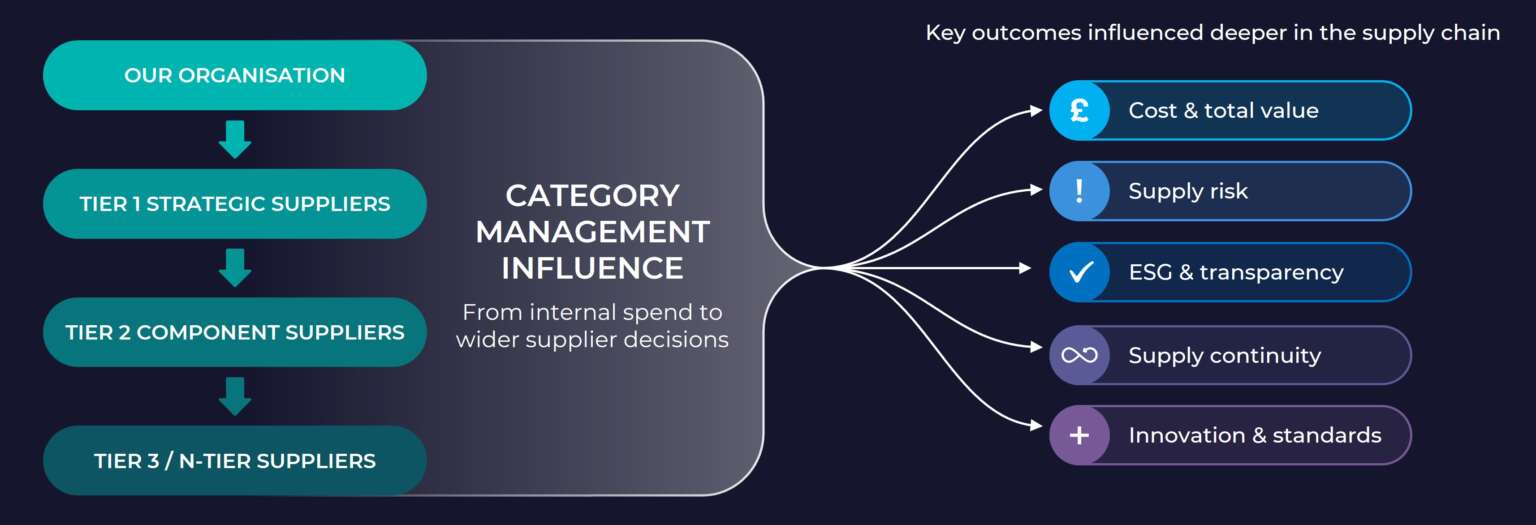
Category Management in the supply chain is a scalpel, not a hammer
By engaging in Category Management with suppliers, objectives related to cost management, labour practices, modern slavery, environmental standards, carbon emissions, and similar areas can be actively promoted and addressed throughout the supply chain. Much like educational programs outlining your expectations for the behaviours of tier 1 suppliers, this approach enables you to influence their own programs more profoundly.
It requires procurement team members who think strategically and can position Category Management positively with their key suppliers and internal stakeholders. The latter group is often more sceptical about what can be achieved from this approach and is concerned that, as the customer, they are taking more control and responsibility for categories that are currently managed by the supply chain, adding additional workload. This approach should, therefore, be focused on suppliers with high impact on cost structures or high potential environmental or supply chain risks only.
The crucial thing is to understand how well tier 1 suppliers are undertaking category management and then to work collaboratively on some high-priority categories to prove the effectiveness of this approach.
Assess the maturity of your category management capability with our Category Management Maturity Assessment, or contact us to discuss extending category management deeper into your supply chain.
Further reading:

About Mark Hubbard
Director
30+ years experience in procurement and supplier management, in line and consulting roles
Previous employment: Positive Purchasing Ltd, SITA,
QP Group, BMW, SWWS, Rover
Education: BSc in Engineering Metallurgy, MBA University of Plymouth
CIPS: Member
Further Reading

Video & Blog
Strategic Procurement: Building Resilient Defence Supply Chains
17/04/2026
Read More

Case study
AstraZeneca
At AstraZeneca the foundations of category management are built on stakeholder engagement
07/11/2023
Read More

Blog
From Spend Analytics to Category Intelligence
07/07/2026
Read More