


Video & Blog
How strategic procurement supports a stronger defence supply chain
By Mark Bassington |
Summary
UK defence procurement is under pressure, and the supply chains that underpin national capability are paying the price.
This blog sets out six procurement challenges facing the sector, from fragile global supply networks to critical skills shortages and fragmented category strategies. We make the case for stronger, more mature procurement practices as an essential step towards building a more resilient defence supply chain.
The UK defence sector is operating under unprecedented pressure from increasing geopolitical instability and growing, but more focussed defence budgets. Last year, the Strategy Defence Review and Defence Industrial Strategy set out challenging expectations across the industrial base.
The UK government is yet to release its widely anticipated Defence Investment Plan, mindful that the previous government and the MOD had allocated £288.6bn on equipment procurement and support over the next decade. However, successive governments and the MOD have struggled to translate this budget into the delivery of key capabilities within agreed costs and timescales. This pressure is not unique to the UK. NATO member states are having similar conversations about defence capability, industrial readiness, and procurement reform.
The supply chains that underpin UK defence were built for a different era. They now need to adapt quickly to a very fast-changing geopolitical environment. This demands bold, coordinated transformation if they are going to respond effectively.
All participants must act now to strengthen resilience across the defence supply chain. This requires a high degree of strategic procurement maturity and sustained collaboration across all tiers of the supply chain. The transformation process starts with each supplier assessing their own maturity and capabilities and building a clear summary of their strengths and weaknesses. Building a shared picture of where we stand today allows us to collectively agree and prioritise the actions to achieve the transformation required.
6 Key defence supply chain challenges and how to solve them
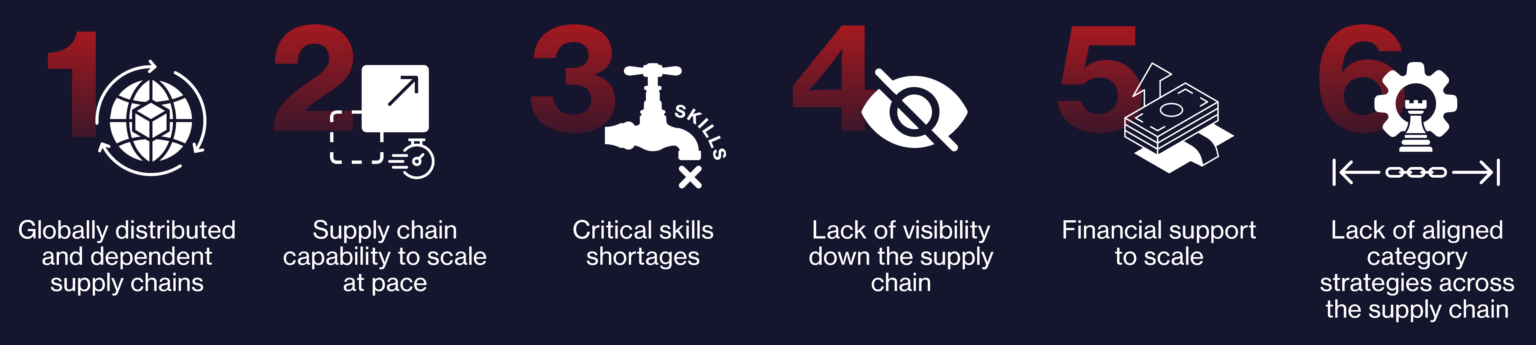
1. Globally distributed and dependent supply chains
The UK defence supply chain is deeply embedded in global supply chains that evolved in an era of free trade and interconnected markets. Only certain areas of the supply chain had any focus on national sovereignty, security or resilience. For decades, the logic was straightforward: source from the suppliers and regions that deliver the best value. But in an era of geopolitical instability, conflicts and systemic global instability, that logic has become a liability.
These factors represent significant risks to defence capabilities. Surging demand for components, combined with shortages and disruption to critical minerals, electronics, or specialist manufacturing impacts the ability to scale up production. Without intervention, the UK risks becoming strategically dependent on overseas suppliers, and supply chains possibly controlled by our adversaries.
What needs to change
- Defence organisations must take a genuinely strategic approach to supply chain design, critically designing their supply chains to mitigate the risks. That means mapping the supply chains and identifying risks, dependencies and opportunities to re-shore or friend-shore key capabilities.
- Industry needs to work collaboratively with MOD and their partners, through the Defence Industry Joint Council and through MOD category leads to identify the scale of defence requirements and develop strategic stockholding policies for critical materials, equipment and components. This is not a one-off exercise, but a sustained endeavour that is critical to building national strategic capability and assets.
- The defence primes need to integrate defence SMEs into their supply chain networks and actively support them to be mature and resilient. The Defence Industrial Strategy points in this direction, and procurement functions need to follow through, treating SME integration as a strategic priority.
2. Supply chain capability to scale at pace
The defence supply chain has evolved for peacetime to deliver steadily, predictably, and within tightly managed cost parameters driven by fiscal pressure and limited Defence spending. However, the commercial frameworks and procurement strategies currently governing procurement are not fit for a world where the ability to scale at pace, and deliver combat mass could be the difference between success and defeat.
Few organisations have robustly assessed their suppliers’ capability to significantly surge capacity and production when required. They do not understand the associated costs, or the lead times and the rates of scaling possible. Importantly, this assessment should evaluate the ability to scale across all tiers of the supply chain and the time taken to qualify an alternative source of supply. This is a critical defence risk; without embedded capacity and surge planning within supply chain strategies and design, the sector will not be able to respond at the pace and scale required.
What needs to change
- Defence organisations need to design category strategies that address surge capacity through supply chain design. They must assess suppliers and their sub-tiers for their ability to scale production, identifying and mapping opportunities for dual-use technologies and capabilities. The cost, time and qualification implications of these options should be clearly modelled to inform decision-making.
- War-gaming must become a core procurement capability to deliver collaborative scenario planning with key suppliers and their supply chains. For critical supply chains, supplier and sub-supplier business continuity and contingency plans need to be regularly reviewed and tested, not filed away.
- Better coordinated planning between MOD and defence sector for high-cost enablers such as common test facilities. The planning needs to identify where there are significant costs to be funded by MOD to accelerate delivering scale efficiently, with reduced duplication and more managed risk.
- Treat scalability and flexibility as a core commercial principle to be built into commercial agreements from the outset. This will give suppliers the confidence to plan and respond to changing delivery profiles, surging capacity, changing volumes and rapid reprioritisation. The supply chain ecosystem can respond at a pace to meet the changes in demand and manage the risks for resilient supply.
3. Critical skills shortages
A growing skills gap across engineering, advanced manufacturing, cyber and digital fields is constraining the sector’s collective ability to address every challenge. An ageing workforce, specialist defence capabilities such as welding, a limited STEM pipelines of talent, and fierce competition for specialist skilled workers from more attractive sectors are all factors. These issues are making it harder for both defence organisations and their suppliers to scale production and deliver critical national security capability. A recent defence industry survey found that 67% of respondents believed that workforce and skills shortages will significantly impact business growth opportunities. Currently there are at least 10,000 stated vacancies across organisations participating in the survey.
This is not simply a workforce problem. It is a supply chain and procurement problem. Without the right skills and capacity at every tier of the supply chain, developing resilience becomes impossible. Strategies that look strong on paper will fail in execution if the skilled people needed to deliver them are not in place.
What needs to change
- A coordinated, sector-wide approach to defence supply chain skills. No single organisation can solve this alone. Investments in apprenticeships, technical training, and STEM talent pipelines are essential. This must be treated as a shared responsibility across the ecosystem and not left to individual organisations to resolve on their own.
- Larger primes to take a lead role, actively supporting their Tier 2 and Tier 3 suppliers in accessing talent pipelines, rather than competing against them for the same scarce resource.
- Closer collaboration between industry, government, and academia. This is the only way to build the critical capabilities the sector so urgently needs at the scale and pace required.
4. Lack of visibility down the supply chain
Most defence organisations have a clear understanding of their Tier 1 suppliers. However, below that, understanding and visibility drops sharply, and the dependencies, vulnerabilities, and pinch points within the deeper supply ecosystem remain largely unknown. Procurement decisions are being made without the full picture – which leads to unmanaged risks and issues.
Without multi-tiered supply chain visibility, organisations cannot identify vulnerabilities, bottlenecks, or hidden dependencies. Their ability to predict, gain early indication of potential disruption and ultimately proactively manage and mitigate disruption effectively and efficiently is severely limited.
What needs to change
- Defence organisations must invest in structured supply chain mapping and risk intelligence capabilities that extend well beyond Tier 1 to manage their supply chain risk.
- MOD suppliers must cooperate in providing supply chain visibility and submit it into its intelligence platform Supply Chain Resilience Improvement Performance Intelligence Tool (SCRIPT). This enables MOD to identify and assess the broader risks across different supply chains and understand the aggregate risk position and enacting mitigations through the supply chain team.
- Defence primes need to build multi-tiered visibility, identifying critical nodes and monitoring supply chain risk at every level. This needs to become a core capability across the defence supply chain ecosystem. Organisations that can demonstrate visibility and effective risk management across their supply chains will be far more likely to win, retain and grow business within the defence sector.
5. Financial support to scale
Even where the procurement intent is strong, and the strategies are sound, there is a fundamental barrier. Many suppliers, particularly SMEs, do not have the capital necessary to invest in the new scale capacity, tooling, and facilities capability and workforce expansion needed to meet growing defence demand. Without financial mechanisms to support scaling, suppliers cannot participate fully in future programmes, however well-designed the procurement approach around them.
What needs to change
- The sector needs to explore targeted financial mechanisms that actively support supply chain scaling, including long-term contracting frameworks, co-investment models, and government-backed financing schemes that give suppliers the confidence to invest in new capacity.
- The sector needs to implement practical financial measures such as faster payment terms and government-backed finance. This can make an immediate and tangible difference to smaller suppliers trying to scale production. Reducing financial barriers for suppliers is not a peripheral concern; it is a prerequisite for building the resilient supply chains the sector needs.
6. Lack of aligned category strategies across the supply chain
Defence procurement does not operate in a vacuum. Yet, the category strategies, where they exist, rarely reflect the full complexity of the supply chain ecosystem. These strategies typically stop at Tier 1, leaving limited or no consideration of the critical subsystems, assemblies, components or raw materials on which the categories depend. Each organisation develops its own strategies, in isolation, without visibility of what others are doing or failing to align around shared priorities.
In highly competitive or constrained sectors, this fragmentation is costly. Organisations duplicate effort, compete for the same scarce resources, drive up costs, and fail to secure the long-term supply relationships that resilience requires. The potential leverage of a coordinated approach remains unrealised. Without coordinated and aligned category strategies cutting through the multi tier supply chain ecosystem, vulnerability is effectively built into the industrial base.
Category strategies in MOD are not just a procurement tool, they are collaborative business strategies aligning and cohering stakeholder requirements. They harness deep supply market expertise, research, facts and data to drive innovation and enhanced military capabilities through more resilient supply chains. This enables MOD to move at pace whilst delivering value for money to taxpayers.
What needs to change
- Organisations must build and retain deep market expertise that strengthens their own category strategies for critical equipment, infrastructure, goods and services.
- Category strategies need to be developed with stakeholders to identify real user needs, both now and into the future. These can include potential surge capacity, alternative solutions, sovereign capabilities and supply chain risk scenarios focusing on broader business value levers and not just demand, price and cost.
- Industry needs to then come together with MOD and wider UK government to develop collaborative category strategies across critical supply chains. This will align government, primes and key suppliers around shared priorities for critical materials, components, technologies and skills. From here, we can form networks to securely share common data and insights and take coordinated action across supply networks.
- Investment in the procurement function is key. Its maturity and expertise helps aligns the ecosystem at every level. Organisations that have not yet built strong category management capability and deep market expertise cannot contribute meaningfully to the collective effort. It is therefore an imperative that organisations understand their existing strategic procurement capability and areas that need strengthening.
The role of Procurement in strengthening the Defence Supply Chain
The six challenges span structural barriers, financial constraints, and capability gaps. But in each case, the route to a solution runs through procurement. The sector cannot build stronger supply chains without first building stronger procurement capability.
Procurement determines which suppliers enter the defence supply chain ecosystem. They determine the suppliers’ level of the involvement, visibility and capacity to scale operations efficiently. When procurement is reactive and transactional, the supply chain can become fragile and fragmented. When procurement is strategic and mature, it becomes the mechanism through which supply chain capability and resilience is built, sustained and continually improved. It is world class.
Two capabilities are central to this:
- Category management creates the coherence, visibility, strategic direction, and supplier relationships that makes the supply chain resilient.
- Supplier management ensures that the relationships underpinning critical supplies are actively developed, monitored, and protected beyond Tier 1.
These are not back-office functions. They are core to delivering national defence capability. Neither capability can deliver at the scale the sector needs without procurement maturity, deep experience and expertise to underpin it. Where maturity is uneven or inconsistent across the supply chain ecosystem, weak links emerge, and the whole supply chain suffers. Building expertise and processes consistently, across every tier, is where the work must start.
How Future Purchasing can help
Addressing these challenges requires more than good intent. It requires procurement as a core organisational competence which is deliberately built, embedded and sustained. Success looks like a procurement team that has the capability and toolkits, coupled with the experience to consistently act on them.
Future Purchasing has a long history of working with the MOD, Tier 1, and Tier 2 suppliers on procurement transformation, category management, and supplier management programmes. We understand the complexity, challenges and constraints of the defence sector, and we know what strong, successful procurement practice looks like at every level of the supply chain.
We bring more than 20+ years of practical client experience across over 350 client procurement and supply chain transformation projects delivered across complex public and private sector organisations. We have 250,000+ data points from our Global Category Management Report and ongoing research. That depth of expertise and insight means we can benchmark your organisation’s current position, identify and prioritise the gaps, and build and support delivery of a practical and realistic roadmap. We work alongside your teams to support implementation, bringing proven cross sector best practice and practical delivery capability to help turn strategy into measurable, sustained outcomes.
Our Procurement Maturity Assessment gives defence leaders a clear, evidence-based view of where their organisation stands today. From there, we can work with you to build the category management and supplier management capabilities that translate procurement strategy into supply chain strength.
Are you ready to build a more resilient defence supply chain? Take the Future Purchasing Procurement Maturity Assessment and get a clear picture of where your organisation stands and what needs to happen next.

Director Public Sector
Principal Consultant in Consulting & Delivery
20 years procurement experience in line management and
consulting roles.
Previous employment: London Underground, British Energy,
QP Group, PwC, Exult.
Education: MCIPS, MBA Strategic Procurement Management, University of Birmingham.
CIPS: member.
Related Insights

Case study
MOD
Kerry Underhill interview – The Ministry of defence is driving acquisition improvements with category management
08/02/2024
Read More

Blog
From Compliance to Innovation: Redefining Public Procurement in 2025
25/02/2025
Read More

Video
The Procurement Academy – Building Lasting Capabilities at GKN Aerospace
09/09/2026
Watch