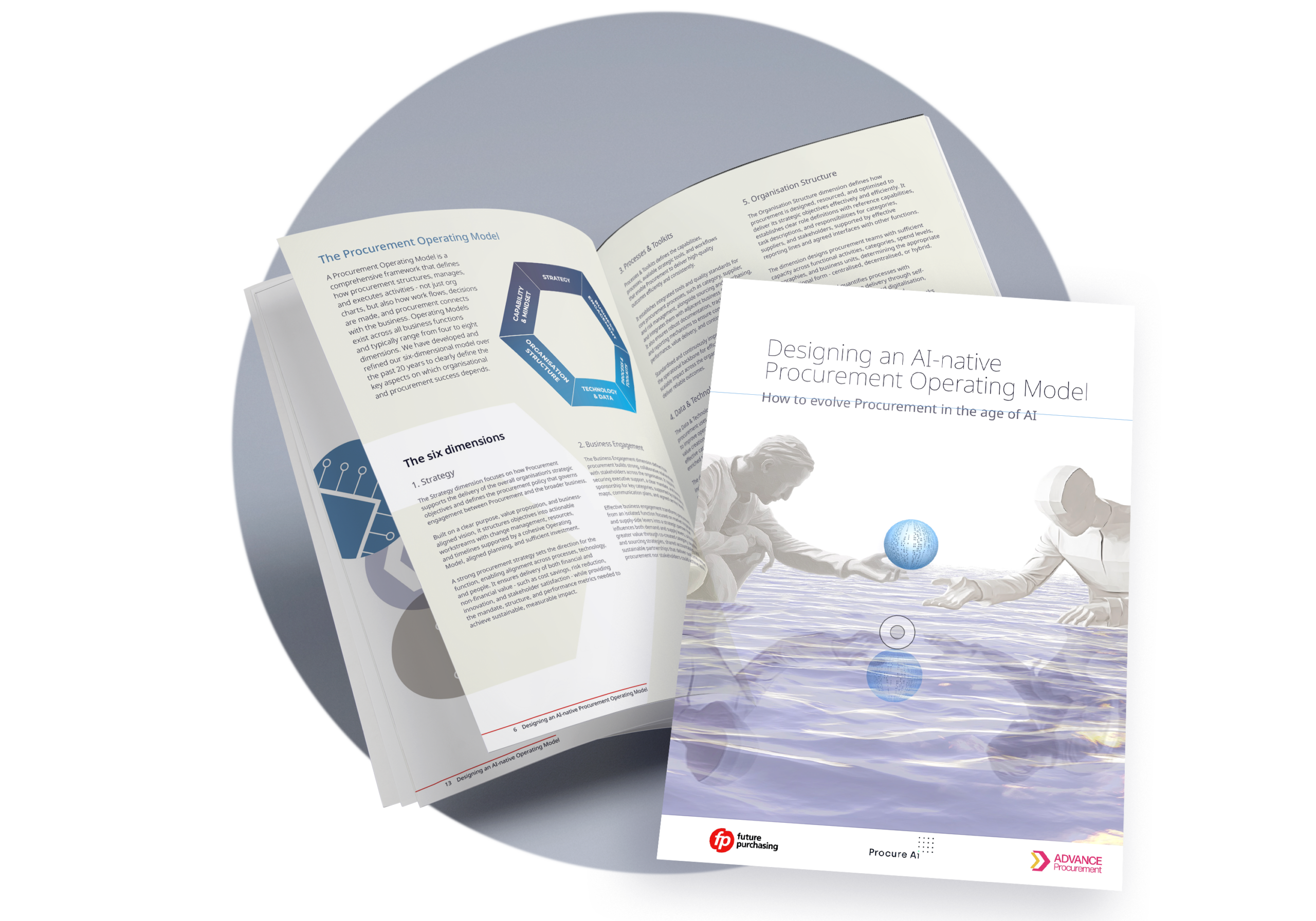


Our Services
Supplier Management
Unlocking the best performance and value from your suppliers with Supplier Management
Supplier management is the systematic approach to get the best value and risk reduction from your supply chain through the lifetime of your relationship.
If you have any doubt about why you need to spend resource on supplier management, consider this:
50%+
Organisations often spend more than 50% of their revenues with suppliers.
55-65%
of innovation comes from suppliers.
11%
On average, supply chain disruptions decrease shareholder value by nearly 11%.
Managing suppliers effectively can differentiate you from your competitors and give you an advantage in your marketplace.
The benefits of a high-quality supplier management approach
There are measurable benefits of well-structured supplier management.
Savings
Organisations that lead in supplier management can deliver average savings of 3-4% on an ongoing basis.
Reduced third-party risk
Although hard to quantify, reductions in third party risk can include supply disruption, reputational damage from impacted customer services and less harmful news impacting shareholders.
Increased innovation
55-65% of innovations are typically sourced externally, and 25-45% of revenues across all sectors come from product innovations.
Our approach to Supplier Management
Future Purchasing helps you build a value-driven approach through consistent and coordinated coaching, training and consulting. The three fundamental foundations of our market-leading methodology are segmentation, performance management and relationship management.
Segmentation in Supplier Management
Our approach to supplier segmentation links business strategy to supplier management, ensuring that we are focussing in the right areas, with the right amount of resource. This is not a static model and will require regular review. It is important that both parties commit to working on joint value creation opportunities. Building this reality into the process means that we can optimise what we are achieving with the supplier base at any one time.


Performance Management
Understanding the performance we are achieving with suppliers is core to making sure we are achieving the value we expect from our category strategies and our contracts. It is well known that the amount of value delivered decreases from the point of contract signing unless we take an active role in managing that delivery. Our starting point is having great performance measurement approaches in place. From here, we can work with suppliers regularly to make sure that performance meets the levels we agreed. If there are issues, we can use well-structured performance improvement tools to deliver the value we expect. This often addresses areas of broader risk management as well as any specific improvements needed.
Relationship Management
A small number of suppliers are often crucial to delivering our organisational strategies. For those suppliers, we need to make sure we have great alignment between what we need to achieve, and the supplier’s focus and capability to deliver those outcomes. By developing the appropriate supplier relationship management strategy, we can manage these essential relationships.
Our supplier management toolkit is fully developed, with a wide range of individual tools, templates and guides that help your teams develop the right approaches and the best outcomes with your suppliers.


“The high standard of Procurement that was taught – the bar and quality was set very high and everyone aimed for it!”
Head of Indirect Purchasing – Multinational Hospitality Company
Simple. Connected.
We reinforce the linkages between supplier management and category management to obtain consistency of process, tools and techniques wherever possible. We aim to make these ways of working simple to understand and easy to use, as they are as likely to be used by business stakeholders as they are by procurement professionals.
This is supported by our world-class education programs, which include both formal training sessions and workshops that address your supplier challenges. We also provide a range of coaching and mentoring approaches to ensure that your team not only understands the concepts and tools but can implement them effectively.
Included in our approach is the full suite of behavioural and change management tools necessary to lead a supplier management programme successfully. This includes a range of stakeholder engagement and communication approaches, designed to encourage the co-creation of performance and/or relationship approaches and deliverables.
What does it take?
Achieving a value-driven approach to Supplier Management and getting the right outcomes often takes time and effort, as we need to develop the right relationship with suppliers, even when the relationship history has been challenging. Making sure that there is a well-managed approach ensuring that delivery stays on track is a factor in maximising the delivery achieved. Our programs all contain progress reviews, resource reviews and checks on the quality of outcome to make sure you get what is needed.
How we can work with you to deliver excellent Supplier Management outcomes
Our consulting, coaching and training services deliver supplier management excellence. They are available to both procurement professionals and stakeholders alike. We blend and customise our three core services to fit your team’s requirements.

Procurement Consultancy
We fill gaps in procurement teams where in-house capability is missing. We undertake planning and strategic alignment activities where there is no internal resource.
Procurement Coaching
Our experts lead virtual or face-to-face classroom events by introducing the key tools and concepts of strategic alignment. Participants build their own strategic alignment plans.

Procurement Training
We work on real strategic alignment projects, providing coached planning support and facilitating key meetings with stakeholders to ensure that tools are applied correctly.
Other areas of expertise

Strategic Alignment
Aligning procurement activity with broader business strategy delivers sustainable outcome, improved stakeholder engagement and competitive advantage

Category Management
Building and implementing category strategies rich with innovation and improvement opportunities is at the heart of long-term business value delivery

Procurement Negotiation
Maximising procurement negotiation outcomes through great planning, technique and alignment with category and supplier strategies
Supplier Management FAQs
What is supplier relationship management (SRM)?
SRM is a strategic approach managing supplier relationships to drive mutual value. Classify suppliers by strategic importance (partners, preferred, transactional, at-risk). Develop tailored engagement for each segment. Collaborate on cost reduction, quality improvement, innovation, and sustainability. Establish KPIs and track performance. Assign relationship owners and hold regular business reviews. Negotiate contracts aligning incentives. Monitor financial health and risks; develop contingency plans. Drive joint improvement initiatives and share benchmarking. Unlike transactional supplier management focused on price and compliance, SRM recognizes suppliers as partners in value creation.
How do you implement a supplier management program?
Assess your current supplier base and relationships; classify as strategic, preferred, transactional, or problematic. Define supplier segmentation and engagement strategy. Establish relationship manager roles with clear decision rights. Create performance KPIs aligned to business priorities. Develop communication strategy by segment with regular business reviews and scorecards. Define joint improvement activities and problem-solving processes. Establish risk monitoring and contingency plans. Implement supplier portal and collaboration tools. Train procurement, business units, and suppliers on new processes. Track program effectiveness and continuously refine. Programs take 6-12 months to implement. Benefits include improved supplier performance, innovation, reduced risk, and stronger competitive positioning.
What role does supplier risk management play?
Supplier risk management is critical to supply chain resilience. Identify risks for each supplier (financial, operational, geopolitical, quality, compliance). Assess probability and impact; prioritize based on consequence. Continuously monitor risk indicators (financial health, news, supply disruptions, regulations). Develop mitigation strategies: diversification, contracts, contingency plans, supplier development. Develop loss-of-supplier contingency plans identifying alternatives. Monitor compliance and ESG standards. Communicate risk assessments proactively. Establish escalation and crisis procedures. Risk management is about understanding and building resilience, not replacing suppliers constantly. Organizations managing supplier risk effectively are far less disrupted by market shocks.
How can procurement strengthen supply chain resilience?
Diversify suppliers—avoid single-source critical materials; build geographic diversity. Maintain strategic safety stock of critical items, balancing holding costs against disruption risk. Negotiate flexible contracts allowing volume, geographic sourcing, and material alternatives. Invest in supplier capability and quality to prevent failures. Understand supply chain networks and identify concentration points and vulnerabilities. Monitor geopolitical, regulatory, and market risks to anticipate disruptions. Support supplier sustainability—sustainable suppliers are more resilient. Collaborate with suppliers and partners, sharing forecasts and communicating changes early. Resilience requires tradeoffs (cost, efficiency) but protects against catastrophic disruptions.
What supplier management software supports strategic sourcing?
Platforms should include supplier portals (communication, order visibility, invoicing), supplier data hubs (master data, financial performance, certifications, compliance), performance dashboards (KPI tracking), RFx management (process, responses, evaluation, scoring), risk monitoring (financial health, news, compliance, disruptions), contract management (centralize, track obligations, renewals), collaboration tools (improvement initiatives, communication), integration (ERP, quality, finance, risk data providers), analytics (dashboards, trends, predictive insights), and mobile access. Examples: Coupa, BravoSolution, Ariba, Determine. Selection should align to your supplier base size, maturity, and priorities.
How can procurement teams negotiate better agreements?
Preparation is essential: understand supplier landscape, define walk-away points, develop strategy, prepare data. Use spend analytics to understand pricing and identify consolidation opportunities. Develop credible alternatives (competitor suppliers, make vs. buy, geographic sourcing) strengthening your negotiating position. Bundle related spend for leverage. Share market intelligence transparently; collaborative negotiation often beats adversarial. Look for win-win trades (volume, payment terms, service levels, flexibility). Anchor negotiations in data (cost benchmarks, market intelligence). Use sequential negotiations to incrementally improve terms. Maintain relationships while negotiating hard. Close clearly and follow up on commitments. Organizations developing strong negotiation capability achieve 3-5% additional savings on negotiated spend.
Latest procurement insights
Be the first to benefit from our Guides, Blogs and Case Studies for best practice in Category Management, Supplier Management, Negotiation and Transformation for the Procurement community.